
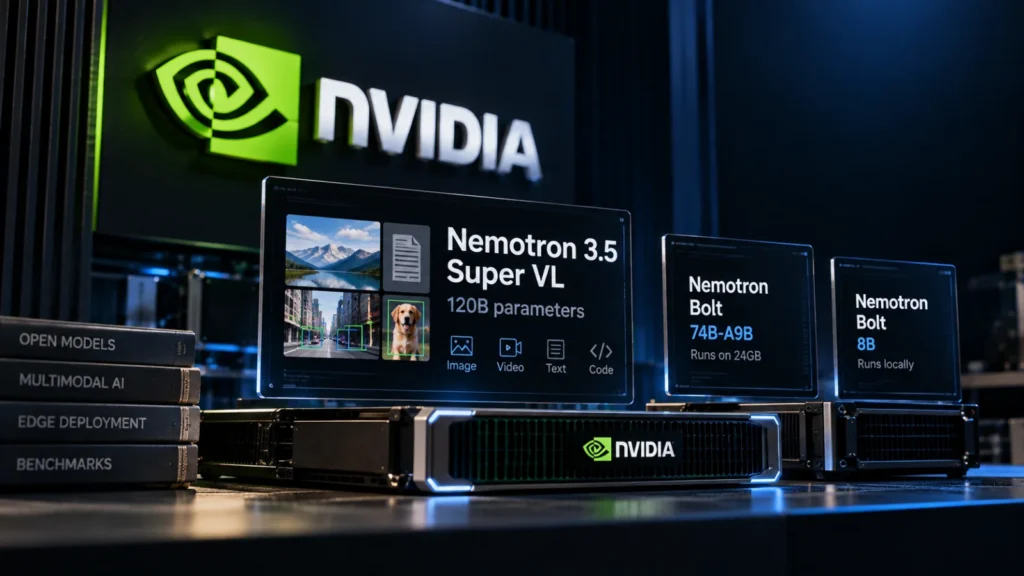
Nvidia released Nemotron 3.5 Super VL on Oct. 15, a 120-billion-parameter open-weight model for agents that handle text, images and video, along with two smaller Bolt models built for local hardware. According to Nvidia’s announcement, Super VL and Bolt 74B-A9B are available now, and Bolt E4B follows on Oct. 23.
TechCrunch’s report ran on Oct. 19, four days after the launch. For developers the useful questions are what each model needs to run, what the license allows, and how much of the performance case has been measured by anyone other than Nvidia. So far, most of it has not.
What does Nemotron 3.5 Super VL need to run?
Super VL is a mixture-of-experts model. It holds 120B parameters but activates 12B per token, which cuts compute per token without shrinking the memory the weights occupy. The model card describes interleaved Mamba-2, MoE and attention layers with a C-RADIO vision encoder, text, image and video input, and context up to 1M tokens.
Nvidia lists four ways to serve it: one DGX Spark, one H200, two H100s or one GB200. The card names Blackwell and Hopper GPUs on Linux, and says the models are designed and optimized for NVIDIA systems. The NVFP4 recipe uses 4-bit weights, with 4-bit activations on Blackwell and 16-bit activations elsewhere, according to Nvidia’s technical blog.
| Model | Size | Hardware named by Nvidia | Availability |
|---|---|---|---|
| Super VL | 120B total, 12B active; up to 1M tokens of context | 1x DGX Spark, 1x H200, 2x H100 or 1x GB200 | Available now |
| Bolt 74B-A9B 24GB | 74B total, 9B active; fits in 24GB | RTX Spark laptops, GeForce RTX PCs, DGX Spark, DGX Station, RTX PRO workstations | Available now |
| Bolt E4B 4GB | 4GB model for conversational agents | GeForce RTX, Jetson, RTX or DGX Spark | Due Oct. 23 |
A model pitched at enterprise servers that also lists a desktop DGX Spark gives teams a way to prototype on one box before moving to data-center GPUs. That is our inference from the deployment table, not an Nvidia statement. Bolt 74B-A9B is supported in llama.cpp, Ollama, LM Studio, Unsloth and vLLM, per Nvidia, and is built for RTX Spark laptops, which Nvidia says arrive Oct. 16.
Quantization has a cost. The model card’s own table shows WebVoyager (offline) falling from 77.72 on the BF16 checkpoint to 66.31 on NVFP4, and DeepSWE from 24.65 to 18.2, while SWE-bench Verified stays flat at 71.10 and 71.07.
Is it open source, and what does the license cover?
BriefFlash uses open-weight here because the license decides the question. The Super VL NVFP4 checkpoint is governed by the OpenMDW License Agreement, version 1.1, and its card says it is ready for commercial or non-commercial use. The license text was not reviewed for this article, and the sources do not confirm which license covers Bolt, so read both before building on either.
Nvidia also says the release includes open datasets on Hugging Face, training recipes, reinforcement-learning environments, and base, post-trained and NVFP4 checkpoints. That is Nvidia’s description; the licensing and completeness of those pieces were not checked.
How does Bolt fit in 24GB, and what does it give up?
Bolt 74B-A9B is Super VL compressed twice. Nvidia’s research page says it shrank the 120B-A12B parent to 74B total and 9B active parameters, cutting expert top-K from 22 to 9, then quantized the experts to 2.0625 bits per element with quantization-aware distillation. The targets were 24GB and at least 80 tokens per second. Nvidia argues that compressing a large model beats training a small one to the same memory budget.
Its own speed table is less flattering. On RTX Spark hardware (a 128GB Surface Laptop Ultra) running llama.cpp on Windows 11, Bolt with its speculative drafter reached 83.99 tokens per second, behind Qwen3.6 35B-A3B at 96.63 and Gemma 4 26B-A4B at 100.56. On a replay of agent trajectories it took 600.80 seconds against 453.97 and 480.68. Only Qwen3.8 27B was slower, at 28.26 tokens per second and 1043.28 seconds.
Nvidia’s case is accuracy per gigabyte. It says Bolt scores higher than those two rivals across many benchmarks and ranks #1 on PinchBench and #2 on both WebArena and BrowseComp among models with a similar memory footprint. The leaderboards were not reviewed, and the rivals ran as UD-Q4_K_M builds. If speed is the priority, this table points elsewhere; if capability per gigabyte is, Bolt is worth testing on your own tasks. That is our reading, not Nvidia’s.
Which of Nvidia’s claims has anyone else checked?
Few. Nvidia says Super VL delivers up to 5x the throughput of open models its size, and shows over 600 output tokens per second on a Baseten endpoint on Artificial Analysis agentic tasks. A separate figure claims 4x faster completion of 10,000 coding tasks on B200 GPUs. Those are different measures, and both are Nvidia’s presentation. It also reports 63.44% on Hermes Bench and 87.05% on LangChain Evals, against 56.33% and 84.3% for Nemotron 3 Ultra, and says an independent EXO Labs evaluation put Super VL on the accuracy and speed frontier on a DGX Spark. That evaluation was not available for review.
Customer lists need the same care. TechCrunch says companies including Skydance and EY are using Super VL. Nvidia’s account is narrower: Scale AI post-trained the model for agents at Skydance and EY, while Atlassian, CrowdStrike, Dassault Systemes, Perplexity, Salesforce and Synopsys are integrating or customizing it. The headline savings are projections: the technical blog says inference cost on the Skydance workload will fall 40x and latency 5x, and that Ramp expects up to 50% higher throughput and 10x lower latency.
Nvidia also says post-trained versions outperform frontier models on specialized tasks. TechCrunch names Anthropic and OpenAI models in that comparison, but the underlying chart could not be read for this article. The comparison set is therefore TechCrunch’s account, and it concerns specialized post-trained models, not the base release.
Why is Nvidia releasing open models?
Kari Briski, Nvidia’s vice president of Open Models and Software, framed the release this way in the announcement:
Any organization that wants to run agents on NVIDIA infrastructure now has an open, optimized model for their tier, without having to choose between capability and deployability.
TechCrunch reports that proprietary labs are looking to AWS Trainium, Cerebras and home-grown chips, and reads the release as Nvidia leaning into enterprises that want to run open models in their own data centers. We would add that open weights loosen lock-in at the model layer, while the tuning around them (NVFP4, NIM, Dynamo, the LiLiCorr drafter) rewards staying on Nvidia hardware. The sources do not test how the models run elsewhere, so we hold that view loosely.
What happens next?
Bolt E4B, a 4GB model for conversational and physical agents on GeForce RTX, Jetson and RTX or DGX Spark, is due Oct. 23. Jensen Huang’s GTC Berlin keynote is listed for Wednesday, Oct. 21. The open items are independent reproductions of the speed and accuracy figures and a confirmed license for Bolt.