
Anthropic has released new technical specifics regarding how its artificial intelligence model, Claude, will implement watermarks to identify AI-generated text and code. The announcement answers critical questions from developers and researchers about the robustness of the detection mechanism, specifically whether heavy editing or paraphrasing can strip the invisible signals. As AI-generated content floods the internet, this traceability is vital for maintaining academic integrity and preventing automated plagiarism.
Following the initial rollout, which sparked intense backlash from some users who fear it will expose unauthorized use, Anthropic shares more information to clarify the system's technical boundaries. The core mechanism relies on statistical patterns embedded during the text generation process, rather than visible metadata or alternate word choices. This approach requires specialized detection tools to verify if a piece of content originated from the Claude model family.
The clarification arrives at a crucial time for the AI industry, as regulators and educational institutions demand reliable methods to distinguish human writing from machine output. Anthropic's documentation outlines how the watermark interacts with programming code, a format where structural changes are easier to automate than in natural language. The company's approach sets a technical baseline that could influence how other AI labs approach content provenance.
Key Takeaways
- Statistical Embedding: Claude's watermarking relies on altering the statistical distribution of token selection during generation, not on visible metadata or hidden characters.
- Code Watermarking: The system applies to code generation but faces unique challenges due to the rigid syntax of programming languages, making detection more complex.
- Editing Resistance: Heavy paraphrasing can degrade the watermark's signal, but Anthropic claims the detection mechanism remains effective against moderate edits.
- API and Consumer Integration: The watermark is applied at the API level, ensuring all outputs from Claude models carry the signal unless explicitly disabled by enterprise clients under specific agreements.
How Claude's Watermarking Actually Works
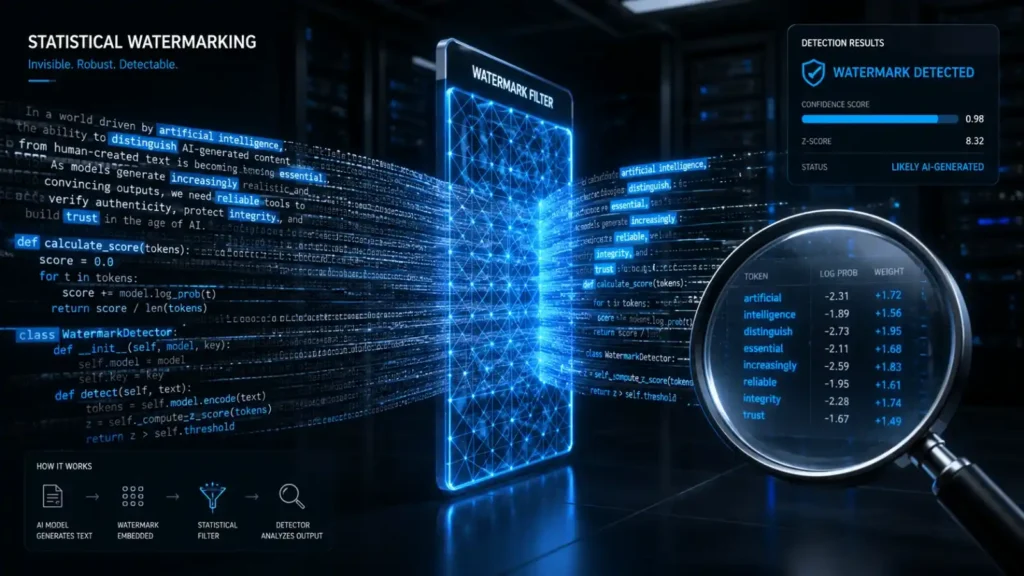
Anthropic shares more technical documentation revealing that the watermarking process is integrated directly into the model's autoregressive generation loop. When Claude generates text, it predicts the next token based on the preceding context. The watermarking system subtly shifts the probability distribution of which tokens are selected. Instead of always picking the absolute most likely token, the system uses a pseudorandom function seeded by the token's hash to occasionally select a slightly less likely token.
This creates a statistical fingerprint. A human writing naturally selects tokens based on semantics and grammar. Claude, under the watermarking protocol, selects tokens based on a combination of semantic likelihood and the hidden mathematical rule. According to the official documentation released by Anthropic, an external detector can analyze a block of text, reverse-engineer the token selection process, and determine if the statistical patterns match Claude's specific watermarking algorithm.
The system does not alter the meaning or quality of the text. Because the shifts in token probability are minor, the generated text remains coherent and contextually accurate. The watermark is entirely invisible to human readers and does not affect the readability or the formatting of the output.
Can the Watermark Be Hidden With Editing?
A major concern among users and reviewers is whether simple edits can strip the watermark. Anthropic shares more details on the robustness of the detection system against post-generation modification. The short answer is that it depends on the severity of the edits.
If a user copies Claude's output and makes minor corrections, such as fixing typos or adjusting punctuation, the watermark remains fully intact. The statistical patterns are distributed throughout the text, so changing a few words does not destroy the overall signal. The detector functions by looking at the aggregate distribution of tokens across a paragraph or document.
However, if a user heavily paraphrases the entire output, replacing nearly every word with synonyms, the watermark will be lost. Anthropic acknowledges this limitation. The watermarking system is designed to catch unedited or lightly edited AI text, which covers the majority of automated spam, low-effort academic cheating, and mass-generated content. It is not a cryptographic guarantee against a determined adversary who rewrites every sentence. This technical limitation is a core focus of ongoing AI safety research, as models balance robustness with generation speed.
How Does This Affect Code Generation?
Watermarking programming code presents a fundamentally different challenge than natural language. Code has strict syntax requirements. A missing bracket or a misplaced semicolon breaks the execution. Therefore, Claude cannot simply swap tokens based on statistical likelihood without risking the functional integrity of the code.
Anthropic shares more details on how the model handles this constraint. For code generation, the watermarking system focuses on specific areas where flexibility exists. This includes variable naming, whitespace insertion, comment generation, and the ordering of independent functions. By concentrating the statistical fingerprint in these flexible regions, Claude can embed the watermark without breaking the code or altering its functionality.
Detection in code works similarly to text. The detector analyzes the file for the specific statistical patterns in the flexible token spaces. If a developer renames all variables and reformats the code using a standard linter, the watermark signal degrades. However, if the code is copied and used directly, or if only minor functional tweaks are applied, the detector can still identify the origin.
This capability is critical for enterprise environments. As companies integrate AI coding assistants into their workflows, tracking the provenance of code helps manage technical debt and security vulnerabilities. The implementation comes at a time when Wall Street is rapidly transforming AI infrastructure into a distinct investable asset class, pushing developers to prioritize verifiable safety standards.
Implications for Developers and Enterprises
The rollout of watermarking has significant implications for the AI ecosystem. For developers using the Claude API, the watermark is applied by default. This means applications built on top of Claude will generate watermarked content automatically. Developers building tools that aggregate or filter AI content can use the detection API to filter out Claude-generated text.
For enterprises, the feature offers a compliance tool. Companies concerned about their internal data being used to train external models, or those needing to verify that contractors are writing original code, can use the detector to audit outputs. The feature also addresses regulatory pressure. Lawmakers in the European Union and the United States are drafting legislation that requires AI companies to label synthetic media. Built-in watermarking provides a technical solution to comply with these upcoming mandates.
However, the system is not foolproof. Bad actors can bypass the watermark by passing the text through a different AI model to paraphrase it, a process known as laundering. Anthropic's approach represents a practical compromise, catching low-effort misuse while acknowledging that absolute cryptographic provenance is currently unattainable in generative models.
Frequently Asked Questions
Is Anthropic going to IPO?
As of August 2026, Anthropic has not filed for an Initial Public Offering. The company remains private, funded by major tech investors and strategic partners. Market analysts frequently speculate on a potential IPO given the company's high valuation and rapid growth in the enterprise AI sector, but no official timeline has been announced.
Is Anthropic a good stock to buy?
Anthropic is currently a private company, so its stock is not available for purchase on public exchanges. Retail investors cannot buy shares directly. Institutional investors and accredited individuals sometimes access pre-IPO shares through secondary markets, but this carries high risk and minimum investment requirements.
Which AI stock will boom in 2026?
Predicting which specific AI stock will boom is speculative and subject to market volatility. However, companies involved in AI infrastructure, specialized semiconductors, and enterprise software integration have shown strong performance. Investors should research public companies in the AI supply chain, such as semiconductor manufacturers and cloud providers, rather than focusing solely on private AI labs.
What would $10,000 invested in Google IPO be worth today?
Google went public in August 2004 at an opening price of $85 per share. A $10,000 investment would have purchased approximately 117 shares. After accounting for stock splits, that initial investment would be worth over $2.5 million today, demonstrating the potential long-term value of foundational tech companies.
Key Takeaways
- Claude's watermarking relies on altering the statistical distribution of token selection during generation, not on visible metadata.
- The system applies to code generation but focuses on flexible areas like variable naming and comments to avoid breaking syntax.
- Heavy paraphrasing can degrade the watermark's signal, but the detection mechanism remains effective against moderate edits.
- The watermark is applied at the API level, ensuring all outputs from Claude models carry the signal unless explicitly disabled by enterprise clients.
FAQ
Is Anthropic going to IPO?
As of August 2026, Anthropic has not filed for an Initial Public Offering. The company remains private, funded by major tech investors and strategic partners. Market analysts frequently speculate on a potential IPO given the company's high valuation and rapid growth in the enterprise AI sector, but no official timeline has been announced.
Is Anthropic a good stock to buy?
Anthropic is currently a private company, so its stock is not available for purchase on public exchanges. Retail investors cannot buy shares directly. Institutional investors and accredited individuals sometimes access pre-IPO shares through secondary markets, but this carries high risk and minimum investment requirements.
Which AI stock will boom in 2026?
Predicting which specific AI stock will boom is speculative and subject to market volatility. However, companies involved in AI infrastructure, specialized semiconductors, and enterprise software integration have shown strong performance. Investors should research public companies in the AI supply chain, such as semiconductor manufacturers and cloud providers, rather than focusing solely on private AI labs.
What would $10,000 invested in Google IPO be worth today?
Google went public in August 2004 at an opening price of $85 per share. A $10,000 investment would have purchased approximately 117 shares. After accounting for stock splits, that initial investment would be worth over $2.5 million today, demonstrating the potential long-term value of foundational tech companies.