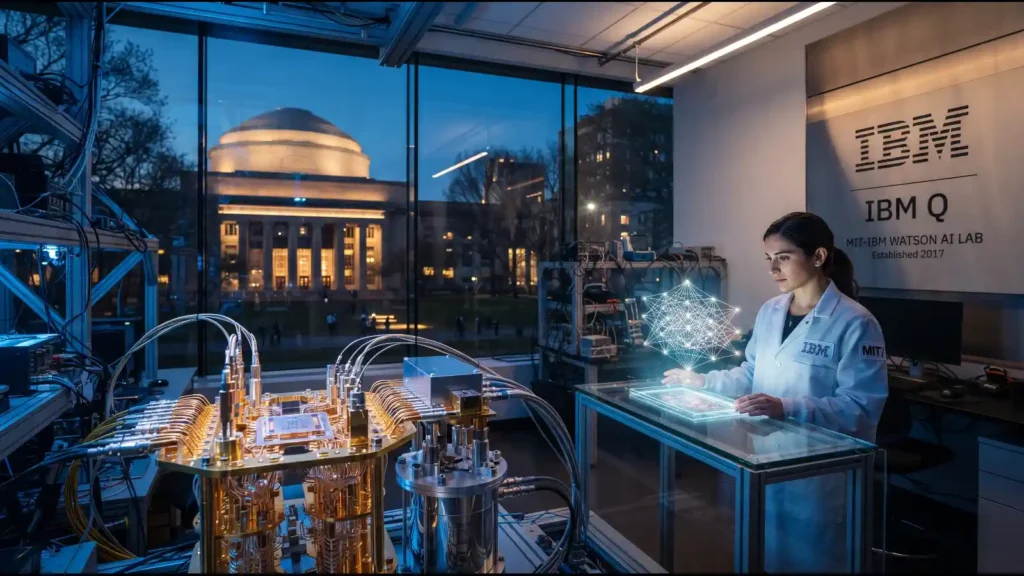
Three researchers who trained at the MIT-IBM Computing Research Lab are now expediting how AI and quantum research moves from academic theory into IBM's production systems, according to a September 2, 2026 profile published by MIT News. Zhang-Wei Hong PhD '25, Irene Ko PhD '24, and former postdoc Srinivasan Arunachalam each built their careers through the lab, which relaunched under its current name earlier this year after a decade as the MIT-IBM Watson AI Lab.
Their work spans three different corners of the field: Hong on reinforcement learning and AI agents, Ko on trustworthy and fair AI, and Arunachalam on quantum machine learning. MIT News frames the throughline as a shared instinct to move ideas from what is possible in principle to what is useful in practice, using the lab as the connective tissue between MIT's theoretical rigor and IBM's production constraints.
The story is also a check-in on the lab itself, which IBM and MIT relaunched on April 29, 2026 with an expanded mandate covering AI, algorithms, and quantum computing. That relaunch, and the track record behind it, is worth unpacking alongside the three researchers' individual work.
Who's Featured, and What They Work On
MIT News profiled three researchers on September 2, 2026, each trained through the MIT-IBM Computing Research Lab and now working at IBM. Reporter Lauren Hinkel frames their throughline as moving ideas from what is possible in theory to what is useful in practice.
Zhang-Wei Hong, PhD '25, started his MIT doctorate in the Department of Electrical Engineering and Computer Science in 2020, advised by Associate Professor Pulkit Agrawal. His early work improved value function learning in reinforcement learning, using the Atari game Montezuma's Revenge to predict and optimize an agent's policy performance. "I'm very excited about curiosity-driven exploration," Hong says, describing the branch of reinforcement learning that lets agents probe new data the way humans do. He is now an IBM research staff member building infrastructure for IBM's agentic framework, covering tasks like chart reading and database tool calling, with a longer-term goal of a framework that lets a model self-evolve its own weights during deployment.
Irene Ko, PhD '24, worked with IBM researchers from the start of her PhD because her research was funded by MIT-IBM. Advised by EECS Professor Luca Daniel and IBM Principal Research Scientist Pin-Yu Chen, she moved from neural networks into foundation models and large language models before joining IBM Research as a scientist in 2024. Her current project, vLLM Hook, reads internal model signals such as hidden states and activations directly from a decoding LLM, instead of adding external monitoring layers the way low-rank adapters do. She describes the lightweight plugin framework as a way to flag safety risks like prompt injection and hallucination at a lower cost than existing methods.
Srinivasan Arunachalam joined MIT as a postdoc in 2018 in Professor Aram Harrow's physics group, after conversations with Professor Isaac Chuang connected him to the lab and to IBM researcher Kristan Temme. His work centers on where quantum computing has a provable edge over classical computing under realistic hardware constraints, like noise and nearest-neighbor architecture. That collaboration produced two papers in Nature Physics, one establishing rigorous guarantees for learning the dynamics of quantum systems, the other providing theoretical evidence that quantum feature spaces can outperform classical kernels under certain hardness assumptions.
The Lab's Track Record
The MIT-IBM Computing Research Lab is a rebrand, not a new relationship. It launched on April 29, 2026, evolving from the MIT-IBM Watson AI Lab, which MIT and IBM established in 2017. The new version adds a dedicated quantum computing focus alongside its existing AI and algorithms work, co-directed by Aude Oliva of MIT's Computer Science and Artificial Intelligence Laboratory and David Cox, IBM's vice president of AI Foundations.
According to MIT and IBM's own joint announcement, the original lab funded more than 210 research projects, involved over 150 MIT faculty members and 200 IBM researchers, and produced more than 1,500 peer-reviewed papers between 2017 and its relaunch, while supporting more than 500 students and postdocs.
Why This Story Matters Beyond Three Career Profiles
Read on its own, this is a recruiting story dressed up as a research story. It was written by the MIT-IBM Watson AI Lab's own communications lead and published through MIT's press office, and it exists to show the lab's return on investment a few months after its April relaunch. That does not make the underlying research fake, but the framing is promotional by design, and it is worth reading that way.
What's genuinely useful here is the texture on how an academic-industry lab actually moves people and ideas into production, something coverage of Diraq's quantum deployment inside an Equinix data center or IBM's own Granite 4.2 reasoning models rarely gets access to. Ko's interest in monitoring model internals for safety signals also sits in the same broader conversation as OpenAI's recurrent-depth reasoning technique, where researchers across the industry are increasingly worried about chain-of-thought becoming harder to audit as models get more capable.
None of the three projects described here, Hong's self-evolving weights framework, Ko's vLLM Hook, or Arunachalam's quantum learning theory work, is described as a shipped IBM product. They are research-stage efforts, and MIT News does not claim otherwise.
What to Watch
Ko's vLLM Hook already has a preprint posted on arXiv, so the next marker to watch is whether it moves from a research paper into IBM's actual inference engine deployments. Hong's framework for models that adjust their own weights at deployment time is explicitly framed as a goal rather than a finished system. In his own words, it depends on being "successful," and whether it clears that bar is worth checking back on.
More broadly, the MIT-IBM Computing Research Lab is still less than six months into its current form. Its next real test is whether the AI, algorithms, and quantum tracks its co-leads outlined in April start producing named, citable results the way the prior decade's Watson AI Lab did.
Key Takeaways
- MIT News profiled three MIT-IBM Computing Research Lab alumni now at IBM: Zhang-Wei Hong (reinforcement learning and AI agents), Irene Ko (trustworthy AI), and Srinivasan Arunachalam (quantum machine learning).
- The lab relaunched as the MIT-IBM Computing Research Lab on April 29, 2026, expanding the decade-old MIT-IBM Watson AI Lab to add a dedicated quantum computing focus.
- Since 2017, the partnership has funded more than 210 research projects and supported over 500 MIT students and postdocs, producing more than 1,500 peer-reviewed papers, according to MIT and IBM's own figures.
- Ko's vLLM Hook project and Hong's self-evolving model weights framework are both still research-stage work, not confirmed IBM products.
FAQ
What is the MIT-IBM Computing Research Lab?
It is a joint MIT and IBM research lab covering AI, algorithms, and quantum computing, launched on April 29, 2026. It evolved from the MIT-IBM Watson AI Lab, which MIT and IBM founded in 2017, and is co-directed by MIT's Aude Oliva and IBM's David Cox.
What did the three researchers profiled by MIT News actually work on?
Zhang-Wei Hong focused on reinforcement learning and AI agents, including work on curiosity-driven exploration and infrastructure for IBM's agentic framework. Irene Ko works on trustworthy and fair AI, including a project called vLLM Hook that reads internal model signals to flag safety risks. Srinivasan Arunachalam works on quantum machine learning, including two Nature Physics papers on Hamiltonian learning and quantum kernels.
Is any of this research already deployed inside IBM's products?
Not according to the MIT News profile. Ko's vLLM Hook exists as a preprint on arXiv, and Hong describes his self-evolving weights framework as a goal he is still working toward rather than a finished system. Both are framed as research-stage projects, not shipped features.