


A new preprint asks whether tuning a small model for healthcare, legal or financial work makes it less trustworthy. The paper is titled Trustworthiness Costs of Domain Adaptation in Small Language Models: A Cross-Architecture Empirical Study. Its subject is domain adaptation small language models trustworthiness: whether a model that gets better at a specialist task also gets worse at knowing when it is wrong.
The authors say the performance gains from this kind of tuning are well characterised, while the effect on trustworthiness is poorly understood. The text available to BriefFlash carries that question and not the answers. This is a preprint, not a peer reviewed paper, so this piece explains the terms and sets out what to watch for.
How might domain adaptation affect small language models trustworthiness?
The paper’s available text does not say. Its title frames a cost, but no calibration or robustness numbers, no direction and no size of effect appear in it. We treat the cost as the question the paper poses, not as a result.
What the paper does state is its premise. According to the authors, domain adaptation of small language models has become a practical strategy for deploying capable NLP systems in resource-constrained, high-stakes settings, including healthcare, legal services and financial analysis. They define trustworthiness here as factual calibration plus adversarial robustness. No architectures, domains, datasets, benchmarks or adaptation methods are named in the text we have.
Why do regulated organizations use small language models?
Small language models are compact enough to run on modest hardware, which is why hospitals, law firms and finance teams favor them over larger systems. The paper itself describes these as resource-constrained environments.
Parameter-efficient fine-tuning, such as LoRA, makes adaptation cheap. Instead of retraining the whole model, it trains a small number of added or selected parameters. Our inference, with moderate confidence: when tuning is this cheap, teams can do it often, and the checking that should follow it may lag behind.
What do calibration and adversarial robustness mean in practice?
Calibration asks whether a model’s confidence matches how often it is right. A well calibrated model that says it is 80 percent sure is correct about 80 percent of the time. A poorly calibrated one gives confident wrong answers, the dangerous case in medicine or law.
Adversarial robustness asks whether the model resists inputs crafted to make it fail or misbehave. The two properties measure different things, so a check on one does not cover the other. A team that tests only accuracy on its target task is testing neither.
What does the abstract establish, and what is still open?
It establishes the question and the gap, not the findings. The table sets out the difference.
| What the available text establishes | What is still open |
|---|---|
| Domain adaptation of small models is described as a practical strategy for high-stakes settings | Whether tuning lowers calibration or robustness, and by how much |
| Performance gains from parameter-efficient fine-tuning are called well characterised | Which architectures, domains, datasets and methods were tested |
| Trustworthiness effects are called poorly understood | Whether any cost is consistent across domains and architectures |
| The authors describe the study as the first systematic cross-domain, cross-architecture look (their claim, unverified) | Whether teams can recover trustworthiness after tuning, and whether findings transfer to larger models |
What we do not know yet: the size, direction and uniformity of any trust cost. The wire text also cuts off mid-phrase, so we are not stating a submission date or anything beyond the visible words.
How does the GRPO paper fit alongside it?
A separate paper, GRPO Training Dynamics for Small Language Models, describes Group Relative Policy Optimization as a memory-efficient reinforcement fine-tuning technique for reasoning-intensive tasks. It says the training dynamics of that method on small models remain poorly understood. Its listing is also cut off mid-sentence, so we state only what the visible text says.
Nothing in that text says it studies trustworthiness, and nothing suggests the two papers are linked by their authors. Our reading, with low to moderate confidence from two short abstracts, is that both describe the same pattern: small model training methods are being adopted before their side effects are mapped.
What should teams measure before deploying a tuned small model?
Measure calibration and robustness on the base model and again after tuning, then compare. This is BriefFlash’s reasoning from the paper’s premise, not a finding of the paper.
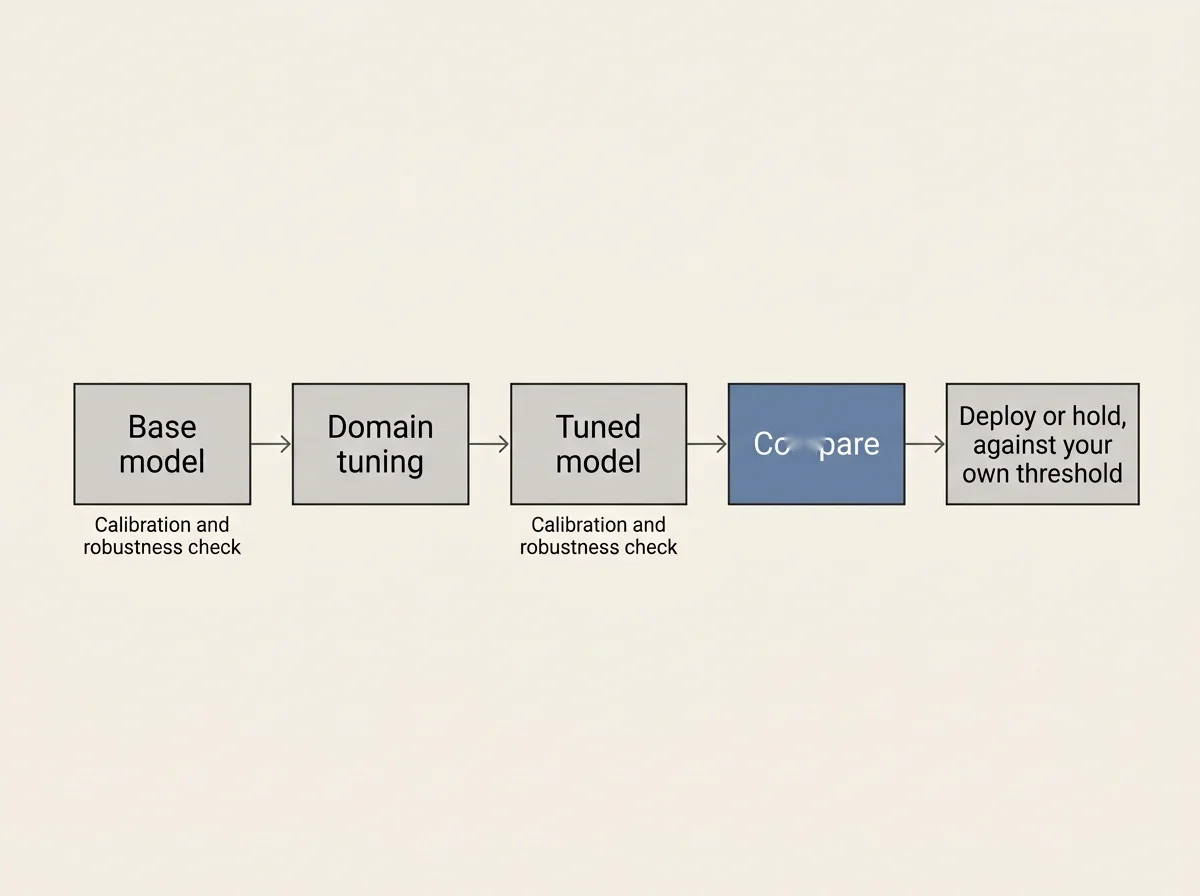
- Record how well the base model’s stated confidence matches its accuracy on a held-out set from your own domain.
- Run inputs crafted to break the model, chosen to match how it will be exposed in deployment.
- Tune the model, then repeat both checks with the same data.
- Deploy only if the post-tuning numbers meet your own threshold for the stakes involved.
The worry resembles the one in reward hacking in rubric-based reinforcement learning, where a training signal can look better than the model underneath. Strong task scores can hide weaker behavior elsewhere. Findings on small models may also not transfer to larger ones.
Watch for peer review, the actual results, the named architectures and domains, and any mitigation the authors test. Until those appear, the paper is a well-posed question, not an answer.
Frequently asked questions
What is domain adaptation of a small language model?
Domain adaptation means tuning a compact language model so it performs better in a specialist field such as healthcare, legal services or financial analysis. Parameter-efficient methods like LoRA do this by training only a small number of added or selected parameters instead of the whole model, which keeps the process cheap.
What do calibration and adversarial robustness mean in practice?
Calibration means a model’s confidence matches how often it is right: 80 percent sure should mean right about 80 percent of the time. Adversarial robustness means it resists inputs deliberately crafted to make it fail. Poor calibration produces confident wrong answers, which is especially dangerous in medicine or law.
Does fine-tuning make a small language model less trustworthy?
That is the question a new preprint poses, but the text available so far reports no results, so the answer is unknown. The authors say trustworthiness effects are poorly understood. The study is not peer reviewed, and findings on small models may not transfer to larger ones.
What should a team check before deploying a fine-tuned small model?
As BriefFlash’s own reasoning, not a finding of the paper: measure calibration and adversarial robustness on the base model, tune it, then measure again with the same data. Compare the results against a threshold that matches the stakes of your use case before deployment.