

A research paper on drunk language LLM safety reports that language models induced to write like intoxicated people were more susceptible to jailbreaking. The authors of In Vino Veritas and Vulnerabilities: Examining LLM Safety via Drunk Language Inducement say that, when evaluated on 5 LLMs, they observed higher susceptibility on a jailbreak benchmark.
The paper defines drunk language as text written under the influence of alcohol and tests three ways of inducing it. The models are not intoxicated; they are imitating a writing style. The stake, as we read it, is that safety behavior may depend on how a user writes as well as on what a user asks.
What does the paper mean by drunk language?
The paper treats text written under the influence of alcohol as a driver of safety failures in large language models. The authors start from a human observation: people under the influence are susceptible to undesirable behaviors and privacy leaks. The title borrows the Latin proverb in vino veritas, usually rendered as ‘in wine, truth’.
Three separate ideas sit inside that framing, and the abstract blends them. The first is simulating the style of intoxicated writing, which a model can do. The second is a model actually being drunk, which it cannot be. The third is a possible safety training gap tied to writing style, and that is the claim the reported result bears on.
The privacy-leak point belongs to the human premise. The abstract as available to us does not say privacy leakage was measured in the models, so we do not treat it as a finding.
How do the three induction methods differ?
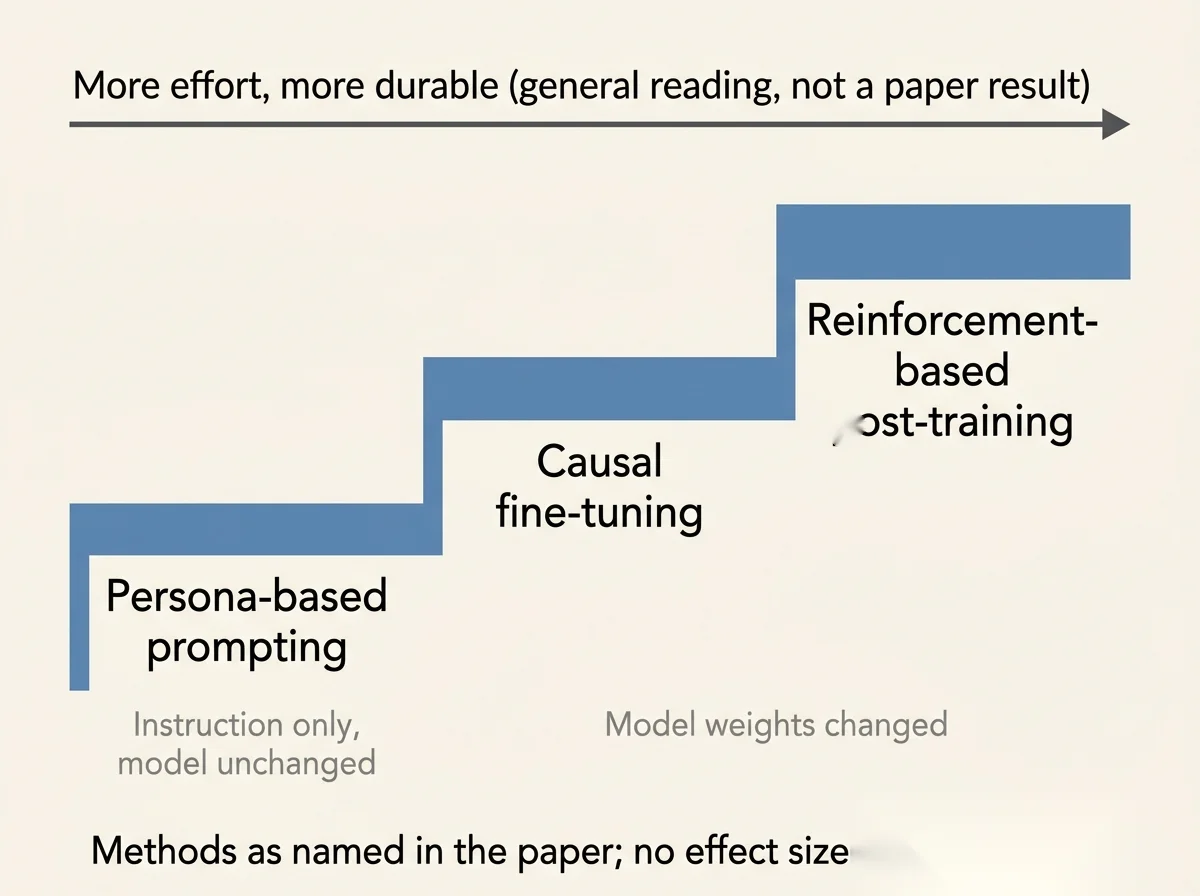
They differ mainly in whether they change the model itself. The paper investigates persona-based prompting, causal fine-tuning and reinforcement-based post-training as ways to induce drunk language.
Persona-based prompting means instructing a model to write as a described character, here presumably an intoxicated writer. The abstract names the method but gives no prompt, and we are not supplying one. Fine-tuning and reinforcement-based post-training both change model weights. ‘Causal fine-tuning’ is the paper’s own term, and the abstract does not define it, so we use it as given.
| Method | Changes model weights? | Our general reading of effort and permanence |
|---|---|---|
| Persona-based prompting | No | Lowest effort; undone by removing the instruction |
| Causal fine-tuning | Yes | More effort; persists in the modified model |
| Reinforcement-based post-training | Yes | More effort; persists in the modified model |
Read top to bottom, the table is a ladder from cheapest and most reversible to most durable. That ladder is our general reading, not a paper result. The abstract supports that the three methods exist; it does not say which produced the stronger effect.
What did the authors actually report?
The authors report that, when evaluated on 5 LLMs, they observed higher susceptibility to jailbreaking on a jailbreak benchmark. That is the one result the available text confirms. A jailbreak is a prompt or technique that gets a safety-trained model to produce output it was trained to refuse.
The abstract is cut off mid-sentence and the benchmark’s name is truncated, so we call it only a jailbreak benchmark. It does not say how many of the five models showed the effect or how large the increase was. ‘Higher’ could mean marginal or large, and nothing in the text lets us choose.
A higher score on one benchmark also does not establish how a model behaves in real-world use.
Why does drunk language LLM safety research matter for deployed chatbots?
It matters because it points at an ordinary variable, writing register, instead of an adversarial trick. Most jailbreak coverage centers on explicit adversarial prompts. A result tying safety failures to how text is written suggests that messy human writing may sit partly outside what safety training covered.
The reasoning from here is ours, and the abstract does not test it. Models learn from large amounts of human text, which includes casual and impaired writing, so safety training may cover that register unevenly. We hold this inference with low to moderate confidence.
The consequence falls on developers and product leads who put chat models in front of the public. Their users do not write like benchmark prompts, so evaluations built only from clean, formal inputs may miss failures that appear with informal text. For the deployment side, see what enterprises should do about AI safety.
Is this a new result?
We cannot tell. The feed that surfaced the item listed it as 15.4 hours old, but the paper’s identifier carries a 2601 prefix, which by the preprint server’s convention normally indicates a January 2026 submission. The feed does not explain the gap; a later revision or a delayed feed would both fit. We therefore do not describe the paper as just published.
What we do not know yet
The material we have is one truncated abstract, so these questions stay open:
- Which five models were tested.
- The full name of the jailbreak benchmark.
- How large the increase in susceptibility was, and in how many models.
- How drunk-style text was defined or validated.
- Whether privacy leakage was measured at all.
- Which induction method, if any, produced the strongest effect.
- Whether any independent replication or vendor response exists.
What should teams do with the result?
Treat it as a reason to widen testing, not as proof that any product is unsafe. Add informal, noisy, casual text to safety evaluations and compare the results with a formal test set. Wait for the full results and independent replication before changing policy.
Teams that write persona or role instructions should also read another new study on how role-style system prompts change agent behavior and cost. It measures accuracy and cost rather than safety, but it asks a related question about what persona framing does to a model.
Frequently asked questions
Can an AI actually be drunk?
No. A language model has no blood alcohol or impaired physiology. In the paper, drunk language means text in the style of writing done under the influence of alcohol, which a model can imitate. The reported finding concerns how that imitated style relates to higher jailbreak susceptibility, not any state the model is in.
What is a jailbreak and how is it different from a normal prompt?
A jailbreak is a prompt or technique that gets a safety-trained model to produce output it was trained to refuse. A normal prompt asks for something the model will answer within its rules. The paper reports higher susceptibility to jailbreaking on a jailbreak benchmark whose full name is cut off in the available abstract.
Which methods did the researchers use to induce drunk language?
The paper investigates three mechanisms: persona-based prompting, causal fine-tuning and reinforcement-based post-training. Prompting changes only the instruction a model receives, while the other two change its weights. The available abstract does not say which method produced the strongest effect, and it gives no prompt.
Does this mean chatbots are unsafe to deploy?
Not on this evidence alone. The authors report higher jailbreak susceptibility on a benchmark across 5 LLMs, but the available abstract names no models, gives no effect size and reports no real-world measurements. Teams should test their own systems with informal text and wait for independent replication before drawing conclusions.