
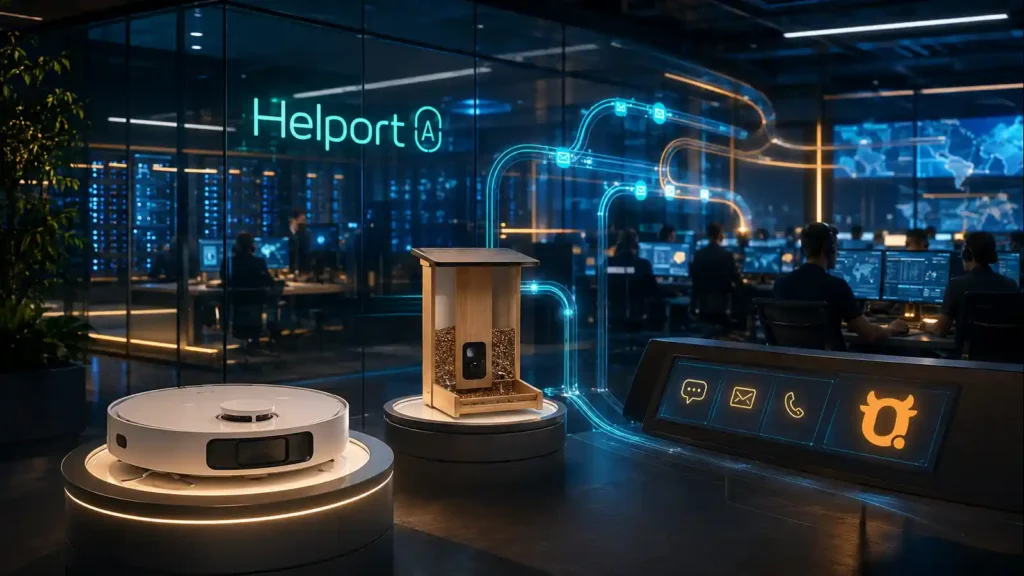
Helport expands labor capacity through its AI Labor platform for global consumer hardware brands, Helport AI announced on August 20, 2026. The revenue-generating deployments now support live after-sales operations across North America and Europe, routing chat, email, and voice requests between trained AI workflows and human specialists.
The move takes Helport beyond conventional agent-assist software. Its AI+BPO architecture treats automation as service capacity: the AI handles first contact and repeatable tasks, while people take exceptions, escalations, and cases requiring judgment. That distinction is commercially important, but the announcement does not disclose the AI resolution rate, customer-level savings, response latency, service-level commitments, underlying models, or pricing. The evidence therefore supports a live deployment story—not yet a proven claim of superior economics at scale.
What did Helport AI deploy?
The official Helport AI announcement says the company is supporting after-sales interactions for connected-device brands across North America and Europe. Customers can arrive through chat, email, or voice. Automated workflows handle first contact and eligible routine requests; human specialists monitor the operation and take over when a case falls outside the workflow or calls for judgment.
The workload includes setup, connectivity, product operation, troubleshooting, warranties, and returns. Those categories are repetitive enough to automate in part, yet consequential enough to need escalation controls. Helport describes consumer hardware and cross-border commerce as its second commercially validated vertical after consumer finance.
How does Helport's AI Labor system work?
Helport AI describes three connected operating layers. First, its Unified Communication Platform (UCP) brings chat, email, and voice into one environment instead of leaving each channel in a separate queue. Second, the AI Labor System applies trained workflows to classify requests, retrieve relevant information, take permitted actions, and complete eligible interactions. Third, human specialists supervise the service and handle exceptions, escalations, and decisions that require context or judgment. This is closer to a managed operational service than a stand-alone software license. Helport owns both the automation layer and part of the delivery process, which may make implementation easier for customers but also concentrates execution risk with the provider. The company tracks “AI penetration” separately by channel as the share of interactions resolved without human intervention. It says chat and email currently carry the highest share, while voice remains lower, but it published no channel-level percentages, accuracy results, or customer satisfaction scores.
Where is the model already running?
Helport entered the hardware segment through direct contracts and an April 2026 partnership with QuickCEP, an omnichannel customer-engagement software provider. Initial customers have been onboarded through that partnership. A separate commercial agreement with Dreame Technology began generating revenue in May 2026, covering overseas contact-center and AI technical services.
Helport also named Birdfy, a smart bird-feeder camera brand, and said it supports a robotic pool-cleaner company and an at-home beauty-device company whose identities remain confidential. The release cites Dreame materials that cite International Data Corporation (IDC) data ranking Dreame first worldwide by robot-vacuum sales volume and revenue in the first quarter of 2026; Helport explicitly says it did not independently verify that third-party ranking.
Why Helport Expands Labor Through Consumer Hardware
Consumer hardware creates a demanding but measurable test. Product launches and retail events such as Prime Day, Black Friday, and Cyber Monday can cause sharp support spikes. A workflow trained on setup, connectivity, warranty, and return questions can absorb some extra demand without the hiring cycle required by a conventional contact center. At the same time, physical products produce hard cases: defective components, ambiguous warranty terms, safety concerns, failed firmware updates, and requests that cross regional rules. A credible system must recognize those boundaries and transfer the conversation with its context intact. That makes escalation quality as important as automation volume. Helport says one local monitoring employee can support messaging volume generated by more than 100,000 outbound call attempts in its consumer-finance operation, but that is a company-reported comparison from a different vertical. It should not be treated as a verified performance benchmark for hardware support.
What does the business evidence show?
Helport's SEC-filed first-half results provide useful context. For the six months ended December 31, 2025, revenue rose 7.7% to $17.7 million, and average monthly AI Assist subscribers increased 16.8% to 37,908. AI+BPO contributed $0.6 million, while gross margin fell from 54.6% to 51.4% and the company recorded a $1.7 million net loss.
“The first half of fiscal year 2026 marked a transition period for Helport AI,” Li said in the filed release. The figures confirm that the managed-service model was already generating revenue before the Dreame agreement. They do not isolate the revenue, margins, retention, or support outcomes of the new hardware deployments.
This matters because Helport's thesis depends on operating leverage: interaction volume should grow faster than human headcount. Investors and enterprise buyers should watch five measures:
- AI-only resolution rate by chat, email, and voice
- escalation and reopen rates
- customer satisfaction and first-response time
- cost per resolved interaction
- revenue and gross margin by AI+BPO deployment
Without those disclosures, the expansion is evidence of adoption rather than proof of better unit economics.
How could Helport's approach affect service jobs?
The immediate design is task substitution, not a human-free contact center. Routine first contacts move to AI, while specialists spend more time on exceptions, judgment, quality control, and workflow supervision. That can reduce demand for some entry-level tasks even if total employment does not fall at the same rate. The transition also raises the value of product knowledge, escalation judgment, multilingual communication, and AI operations skills—an issue reflected in the broader enterprise AI skills gap.
The model also creates governance work. Companies need audit trails, access controls, escalation thresholds, regional privacy handling, and a clear owner when an automated response causes harm. Similar multi-agent coordination risks show why monitoring cannot be reduced to a nominal human-in-the-loop label. Unlike the embodied automation discussed in LG's physical AI deployment, Helport is automating communication workflows around hardware rather than physical manufacturing or repair.
What comes next?
Helport has moved its AI Labor concept into named, revenue-producing consumer-hardware accounts and multiple service channels. The next test is disclosure. Channel-level automation rates, resolution quality, escalation outcomes, contract retention, and deployment margins would show whether the same operating model can transfer from consumer finance to hardware without weakening service. Until then, the announcement demonstrates commercial reach and a repeatable architecture, while the central economic claim remains a company thesis still being validated.
Key Takeaways
- Helport AI now supports live after-sales operations for consumer hardware brands across North America and Europe through chat, email, and voice.
- Its three-layer AI+BPO model combines a unified communications platform, trained AI workflows, and human exception handling.
- Dreame Technology and Birdfy are named customers; two other hardware clients remain confidential.
- The deployments generate revenue, but Helport has not disclosed resolution rates, SLAs, customer savings, model details, or hardware-specific margins.
FAQ
Will AI completely replace human labor?
Current evidence does not support complete replacement. The International Labour Organization reported in 2025 that one in four workers worldwide holds a job with some generative-AI exposure, but only 3.3% of global employment falls into its highest-exposure category. The ILO says job transformation is more likely than wholesale replacement. Helport's deployment follows that pattern: AI handles eligible routine interactions, while people manage exceptions, escalations, and judgment-heavy cases. Some tasks and entry-level roles may still shrink, even when entire occupations remain.
How does artificial intelligence affect the labor market?
AI changes the mix of tasks, skills, and staffing within jobs. It can automate repeatable work, raise the output of specialists, create roles in workflow design and supervision, and shift demand away from routine service tasks. The effect is uneven across occupations and countries. In Helport's model, the intended economic change is for service volume to rise faster than human headcount, while human work concentrates on complex cases. Whether that produces better jobs or mainly reduces labor demand depends on training, deployment quality, worker consultation, and how productivity gains are shared.