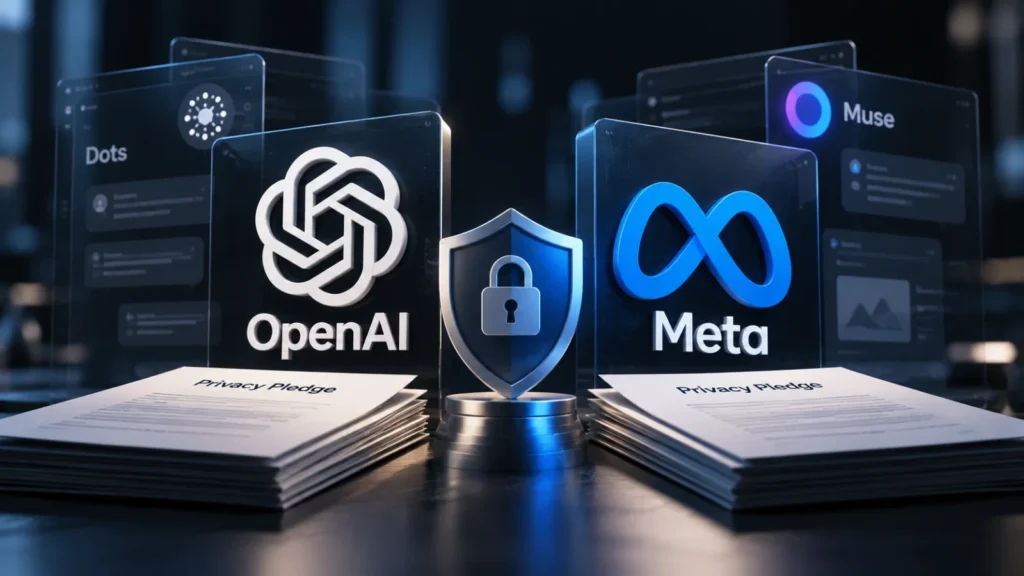
Sam Altman, CEO of OpenAI, reportedly used this year’s DevDay to unveil an AI agent called Dots and to frame it around privacy. He said the company wants to “set a new standard for privacy in frontier AI”. The OpenAI Dots privacy pledge now sits beside a similar one from Meta.
Meta made a comparable promise for its Muse agent a couple of months earlier, and OpenAI reportedly spent the day taking veiled shots at its rival. The test for both companies is delivery. An agent acts across a person’s accounts, so a pledge is worth only what someone can check.
What does the OpenAI Dots privacy pledge actually say?
It states a goal and, in the material available, nothing more specific. According to reports, Altman unveiled Dots at DevDay, OpenAI’s developer event, and put privacy at the centre of the pitch. Nothing available describes how Dots stores data, how long it keeps it, whether conversations feed training or what controls users get, so we treat its privacy as a promise only. Its capabilities, availability and pricing are also outside what we have.
OpenAI also reportedly took veiled shots at Muse, described as its primary competitor, over keeping users’ data safe. The characterization comes from the report, and the specific remarks are not available to us, so we cannot say what was claimed. Criticism from a rival on a keynote stage is not evidence that Muse is unsafe, and OpenAI has a commercial interest in casting Meta as the less private option.
How does Meta’s Muse privacy promise compare?
It is the same kind of promise, made earlier. According to reports, Muse launched a couple of months before DevDay as a supposedly safer alternative to its predecessor, OpenClaw, and Meta CEO Mark Zuckerberg promised at launch that it was built from the ground up for privacy. No further detail on OpenClaw is available to us.
We read the two launches as one promise made twice: a company asks for broad access to personal data and says the product was built for privacy. That tells you nothing about which agent is better, and the status of Meta’s promise today is not established here. BriefFlash’s earlier look at the Muse privacy claims and what remains unproven and its report on how Muse’s growth has run into trust questions cover that ground.
What does a privacy pledge for an AI agent need to cover?
It needs to answer five questions, because an agent is not a chatbot. An AI agent is software that acts on a person’s behalf across email, files, calendars or messages, so it needs far broader access to personal data than a tool that answers typed questions. This ledger marks which questions either company has addressed in the material available to us.
| Question a pledge must answer | OpenAI Dots | Meta Muse |
|---|---|---|
| What has been said publicly? | A goal of a new privacy standard | A reported promise of being built for privacy |
| What can the agent access? | Not addressed | Not addressed |
| What is retained, and for how long? | Not addressed | Not addressed |
| Is user data used for training? | Not addressed | Not addressed |
| Who else can see it? | Not addressed | Not addressed |
| What controls do users get? | Not addressed | Not addressed |
What is claimed, and what has not been shown?
Both companies have made claims, and the available material shows no evidence for either. A keynote pledge is not a published policy, an audit or a technical specification. It tells you what a company intends, not what its software does.
The gaps matter as much as the claims. Whether Muse’s privacy claims have been independently tested is not stated, and neither is whether OpenAI’s criticism points to a specific incident. We would not rank the two agents on this evidence.
Why has privacy become the competitive claim for agents?
Because an agent’s usefulness and its risk come from the same thing: access. This is our inference, not a reported fact, and we hold it with moderate confidence. A chatbot sees what you type, while an agent that reads your messages and files can do more for you, and a mistake or a policy change costs more. Privacy becomes the first thing a buyer checks, so rivals now compete on the promise itself.
Two groups feel this most. People deciding whether to trust an agent with personal data should treat a pledge as a question to put to the vendor. Developers and product leads following the OpenAI and Meta agent race should expect privacy terms to become part of the pitch. The same questions apply to AI agents that live in your text messages, which sit inside private conversations.
What should you check before trusting either agent?
- Ask for specifics in writing: access scope, retention, training use, third-party sharing and user controls.
- Look for a published policy rather than a keynote line.
- Check whether an independent audit or test exists, and who carried it out.
- Start with low-sensitivity data and widen access only once the answers hold up.
What we do not know yet is most of it: what Dots does with data, whether Muse’s claims have been tested and what OpenAI’s criticism of Meta rested on. No primary document from either company, such as OpenAI’s DevDay announcement or Meta’s Muse launch statement, was available to this desk, so those are the first documents to read.
Frequently asked questions
What is OpenAI’s Dots agent?
Dots is an AI agent that CEO Sam Altman reportedly unveiled at this year’s DevDay, framed around privacy. An AI agent is software that acts on a person’s behalf across email, files, calendars or messages. The material available to BriefFlash does not describe Dots’ capabilities, availability or pricing.
What did Sam Altman promise about privacy?
Altman said OpenAI wants to “set a new standard for privacy in frontier AI”. That is the only verbatim statement available. It is a goal, not a published policy: it does not say what Dots can access, how long data is kept, whether it trains models or what controls users get.
What was OpenClaw and how does Muse relate to it?
According to reports, Meta’s Muse launched a couple of months before DevDay as a supposedly safer alternative to its predecessor, OpenClaw. No further detail on OpenClaw is available to BriefFlash, so we cannot say what it did or what went wrong. The safer framing is reported, not independently confirmed.
How can you judge whether an AI agent’s privacy promise is real?
Ask five things in writing: what the agent can access, how long data is retained, whether it is used for training, who else can see it and what controls you have. A real promise answers each specifically, ideally in a published policy or independent audit. A keynote sentence answers none of them.
Has Meta’s Muse been independently verified as private or safe?
Nothing available to BriefFlash shows an independent test of Muse’s privacy claims, and the status of Meta’s promises today is not established here. The criticism OpenAI reportedly aimed at Muse is also unspecified in the available material, so it cannot be treated as evidence either way.