

A new arXiv preprint, Frontier Learning: Training LLM Reasoners at the Edge of Capability, argues that reasoning models trained with reinforcement learning run out of useful problems as they improve. The frontier learning LLM reasoners argument is aimed at pipelines that pick a problem set once and never change it.
The stakes are about cost. Reinforcement learning after pretraining is how current models get better at reasoning, and if a fixed pool stops producing learning signal, compute goes into examples that teach nothing. The wire carries the problem statement but not the method or results, so this piece explains the problem and makes no performance claims.
What does the frontier learning LLM reasoners paper claim?
The paper claims that training reasoning models on a fixed set of problems eventually stops teaching them much. According to the arXiv abstract, listed under cs.CL, cs.LG and cs.AI, reinforcement learning based post-training has been applied successfully to improve reasoning in large language models. Existing pipelines, the authors say, mostly finetune on a fixed pool of problems specified before training, using the GRPO loss.
The authors call that setup fundamentally limiting. Their argument is that learning signal arises only when a model’s rollouts on a problem mix successes and failures. As the model improves, the useful portion of any fixed pool quickly becomes stale.
The title suggests the remedy is to concentrate training on problems near the limit of what the model can currently do. That is a reading of the title, not a description of the method. The wire’s excerpt is cut off before the authors explain how problems are selected or generated, so I am not going to guess.
How does GRPO training work, and why would a problem go stale?
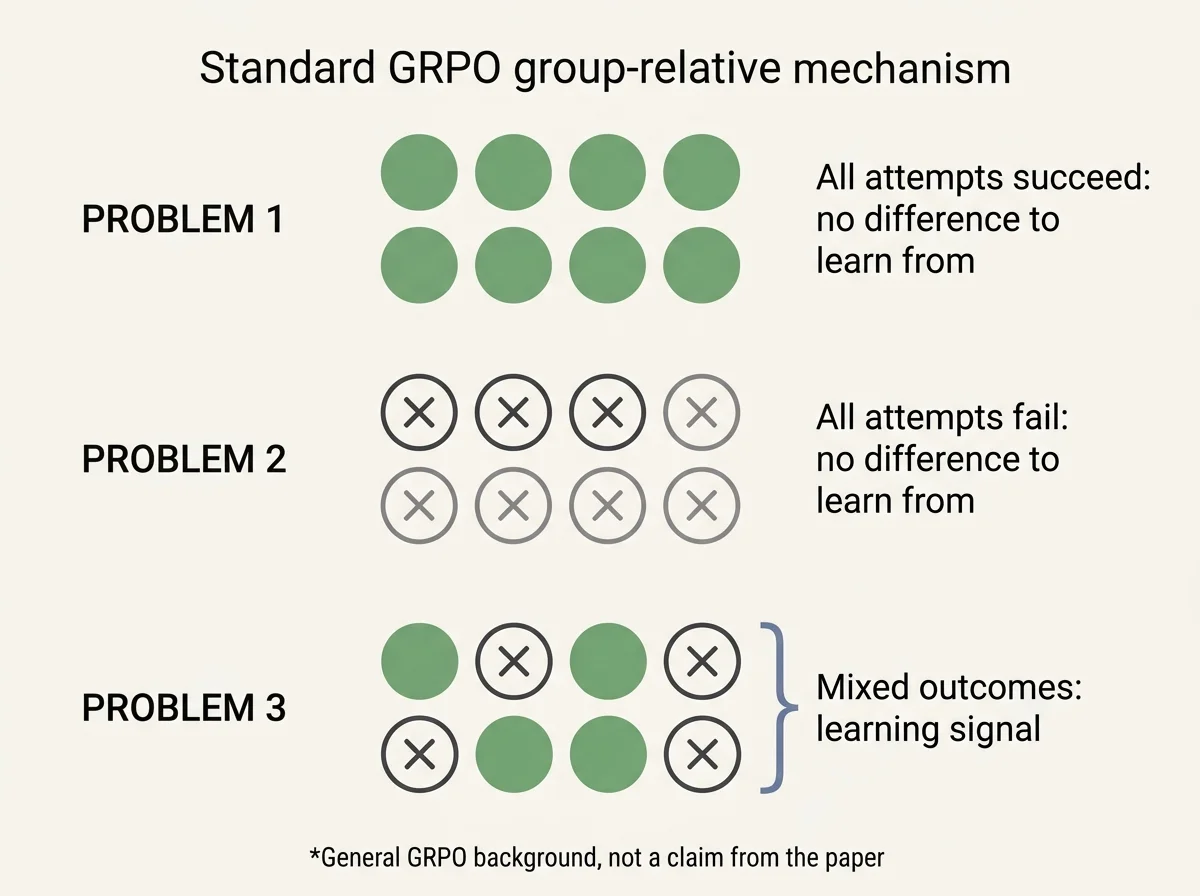
A problem goes stale when the model’s attempts on it all look the same, because then there is nothing to learn from. The following is general background on standard GRPO, not a claim from the paper. After pretraining, a model attempts problems, a reward scores each answer, and the model is updated to make higher-scoring behavior more likely.
GRPO stands for Group Relative Policy Optimization. For each problem the model generates several attempts, and each attempt is judged relative to the others in its group. If every attempt succeeds, or every attempt fails, there is no difference to compare. That is the situation the paper describes as a stale problem.
A teacher who keeps setting the same worksheet is a fair analogy, and only an analogy. Once the student gets every question right, the worksheet no longer teaches anything, though marking it still takes time. In training, the marking is compute spent generating and scoring attempts.
Which of the six arXiv papers on the wire are about this?
Only one of the six papers grouped under this story is about the problem described here. The others share words like ‘frontier’ or ‘edge’ in unrelated senses, and they are easy to confuse. Here is a short guide, based on their stated topics.
| Paper (arXiv ID) | What it is about | Relation to Frontier Learning |
|---|---|---|
| Frontier Learning (2609.35426) | Fixed problem pools going stale in GRPO training | The subject of this article |
| Budget-Aware LLM Discovery (2607.26828) | Credit assignment in adaptive discovery controllers, where prompt length and retries also carry cost | Uses ‘frontier’ in a different sense |
| Goal-Conditioned Supervised Learning for LLM Fine-Tuning (2605.16345) | An alternative to online RL alignment | Different approach to fine-tuning |
| Muon and the edge of stability (2609.34915) | Optimiser dynamics in pretraining | Unrelated use of ‘edge’ |
| Climbing the Hill (2609.33628) | Curriculum reinforcement learning to train an attacker LLM for prompt injection red-teaming | Adaptive difficulty in a security setting |
| FlexQuant (2501.07139) | Running LLMs on edge devices through quantisation | Unrelated use of ‘edge’ |
Nothing in these abstracts says they support or contradict Frontier Learning. The wire also tagged the cluster with legal, benchmark and pricing signals, but none of the six abstracts contains legal, benchmark or pricing information.
What is still unproven about frontier learning?
Nearly all of the performance question is still open, because the wire carries none of it. The paper is an arXiv preprint, and there is no sign of peer review or independent replication. No benchmark results, model sizes, compute costs or authors appear in the material available.
A problem only teaches something when the model’s attempts on it are a mix of successes and failures.
The staleness claim is the authors’ own framing. What we cannot see is how large the effect is in practice, or how much a method built around it helps at scale. That depends on which models, which benchmarks and what compute cost, all of which sit beyond the excerpt.
Why does the fixed problem pool matter?
It turns data selection into a cost question. Training problems are usually chosen once and left fixed, so if the useful part of the pool shrinks as the model improves, a lot of compute goes into examples that no longer teach anything.
It also connects to a thread we have followed: where the learning signal in reasoning training comes from. Our explainer on how stepwise intrinsic rewards train LLM reasoning covers one way signal is built, while this paper is about which problems produce signal at all. For a concrete reasoning model and the training behind it, see how IBM built its Granite 4.2 reasoning models.
Reader interest in the area is up today. ‘Reinforcement’ and ‘Large Language Models Hack Rewards’ are among the rising subjects on the wire, though nothing links either to this paper.
What should readers watch for next?
The evidence that would settle this is in the paper’s method and results: which models were trained, on which benchmarks, and at what compute cost. Independent reproduction would matter more than any author-reported number. Until then, the idea is plausible, since group-relative training does need mixed outcomes, but the answer the paper offers remains unverified.
Frequently asked questions
What is GRPO and how does it train reasoning models?
GRPO, or Group Relative Policy Optimization, is a reinforcement learning method used after pretraining. For each problem the model generates several attempts, and each is judged relative to the others in its group. Higher-scoring behavior is made more likely. This is standard background, not something specific to the Frontier Learning paper.
Why would a fixed problem pool stop being useful during training?
The Frontier Learning authors argue that learning signal arises only when a model’s attempts mix successes and failures. As the model improves, more problems in a fixed pool can end up solved every time, so the useful portion shrinks. That is the paper’s own framing, and the size of the effect in practice has not been shown.
Does the Frontier Learning paper show better results than existing methods?
Not in the material available so far. Only the opening of the abstract, which states the problem, has been reported, with no benchmark results, model sizes, compute costs or authors. The paper is an arXiv preprint with no sign of peer review or independent replication, so any improvement claim remains unverified.
Where can I learn more about how reasoning models are trained?
BriefFlash has an explainer on how stepwise intrinsic rewards train LLM reasoning, which covers another way training signal is built for reasoning models. A separate piece looks at how IBM built its Granite 4.2 reasoning models. The Frontier Learning preprint itself is available on arXiv under ID 2609.35426.