
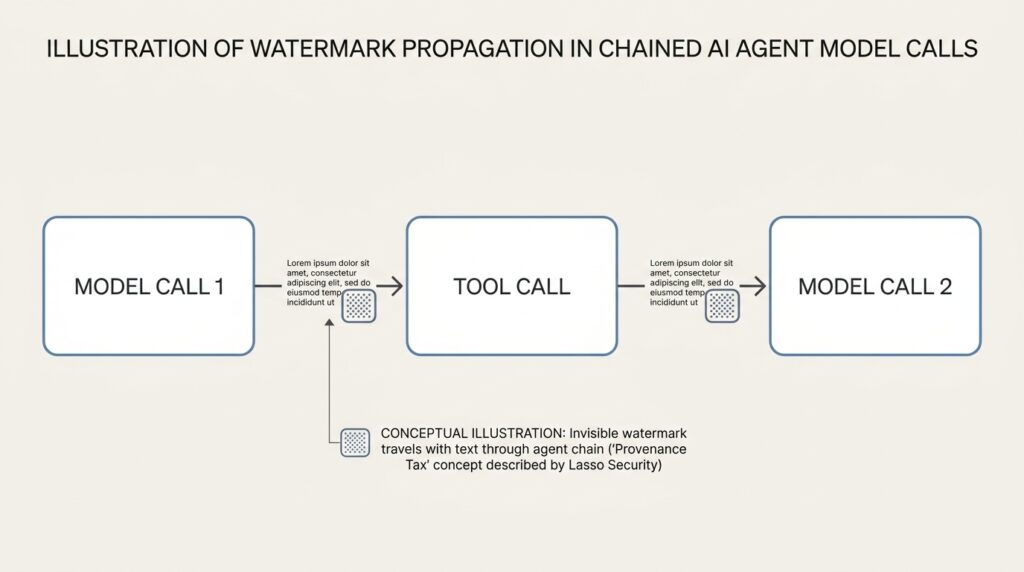
AI security company Lasso Security has published a blog post about the LLM watermarking AI agents encounter once they start chaining model calls together, titled ‘The Provenance Tax: Understanding the Impact of LLM Watermarking on AI Agent Behavior.’ The post examines what happens when watermarking, the practice of embedding a detectable signal inside AI generated text, meets the layered way agents actually operate, rather than a single chatbot reply.
That question reaches beyond one company’s blog. As more AI labs build watermarking into model outputs to make AI generated content traceable, anyone running production AI agents needs to know whether that tracking changes what the agent does: whether it adds latency, alters output quality, or breaks a chain of tool calls in ways nobody designed for. Lasso Security’s post raises that question. It does not, by itself, settle it.
What Lasso Security Actually Published
Lasso Security published a single blog post laying out its ‘provenance tax’ framing, and beyond the title itself, the specifics of what the post found have not been independently verified or corroborated by another outlet. Lasso Security operates in the AI security space, the part of the security industry focused on the risks introduced when large language models and AI agents get deployed inside real products and workflows. The link has also surfaced in at least two Hacker News discussion threads, though both simply point back to the same Lasso Security URL rather than adding independent data or a second source. That’s also why a lone vendor post about a security risk deserves the same read as any other single source claim: informative on its own terms, but not yet cross checked.
What LLM Watermarking AI Agents Face, Explained
LLM watermarking is the practice of embedding a statistical pattern inside text a model generates, one that isn’t visible to a human reader but that a detector can later use to flag the content as AI generated. It has become a live engineering and policy topic as AI generated text spreads across search results, social platforms, and internal enterprise tools, making it harder for a reader, a platform, or a regulator to tell where a given piece of content actually came from. Watermarking is one proposed answer to that problem, though how it’s implemented, and how reliably it survives editing or reuse, varies by company.
- Distinguishing AI generated text from human writing as the two get harder to tell apart
- Giving platforms and researchers a way to trace where a piece of content originated
- Supporting emerging disclosure and labeling expectations for synthetic content
Why AI Agents Face a Different Watermarking Problem Than a Single Chat Reply
A chatbot typically produces one generated reply that a person reads and the interaction ends there. An AI agent works differently. It often chains several model calls together, sometimes feeding one step’s output into a tool call, then feeding the result of that tool call back into another model call to decide what happens next. That kind of chaining has become common as agent frameworks move away from a single request and response pattern and into workflows that plan, call tools, and revise their own output across several turns before a person ever sees a final result. Watermarking built for a single response has to survive that entire chain: it can be read, rewritten, summarized, or passed through a tool at each step, and any of those steps could weaken, strip, or interact unpredictably with a signal that was never designed to travel through more than one hop.

A chatbot produces one answer. An agent produces a chain, and a watermark has to survive every link in it.
What the ‘Provenance Tax’ Framing Claims, and What It Doesn’t
The material available for this story carries only the blog post’s title and its publishing source, not its data, methodology, or specific conclusions, so those specifics can’t be reported here. What can be said plainly: ‘provenance tax’ is Lasso Security’s own phrase, coined for this post, and it should be read as one AI security vendor’s framing of a risk category rather than a peer reviewed finding or an industry consensus term. That distinction matters for the same reason it always does with vendor published security research: a company writing about a risk it specializes in may also have a stake in how seriously that risk gets taken. Nothing here says the analysis is wrong. It says it hasn’t been checked by anyone outside the company that wrote it.
What to Watch Next
The next useful signal will be whether independent researchers, other AI security vendors, or the labs that build watermarking into their own models respond to Lasso Security’s framing with their own testing. A follow up post from Lasso Security itself, with actual data behind the ‘provenance tax’ concept, would also change how much weight the claim deserves. Until then, treat this as a named concept worth understanding, not a verified cost anyone has measured.
Frequently asked questions
What is LLM watermarking?
LLM watermarking is a technique for embedding a statistical pattern inside text generated by a large language model, one that isn’t visible to a human reader but that a detector can later use to flag the content as machine generated. It’s a tool researchers and platforms are exploring as AI generated text becomes harder to distinguish from human writing, though implementations and detection methods vary across companies.
What does ‘provenance tax’ mean in this context?
‘Provenance tax’ is the term Lasso Security uses in its own blog post for the practical cost, in behavior, reliability, or output quality, that watermarking can impose once AI generated text moves through an AI agent’s chained steps rather than staying inside a single chatbot reply. It’s the company’s own framing, not an established industry term, and the specific costs it describes haven’t been independently verified.
Who is Lasso Security?
Lasso Security is an AI security company, part of the growing corner of the security industry focused on risks introduced by deploying large language models and AI agents inside real products. The ‘provenance tax’ post is the company’s own blog content, published to make a case about a specific risk category rather than an independently reviewed academic study.
How could watermarking affect AI agent behavior differently than a single chat response?
A chatbot typically produces one generated reply. An AI agent often chains several model calls together, sometimes feeding one model’s output back into another step or a tool call. That layering means a watermark embedded early in the chain has more places to degrade, get stripped, or interact with later steps in ways a single response never has to survive.
Is this an independent study or a company blog post?
It’s a company blog post. Lasso Security published the ‘provenance tax’ piece on its own site, and no peer reviewed study, dataset, or independent outlet has corroborated its specific claims. Two Hacker News threads have linked to the post, but both point back to the same original source rather than adding outside verification.