

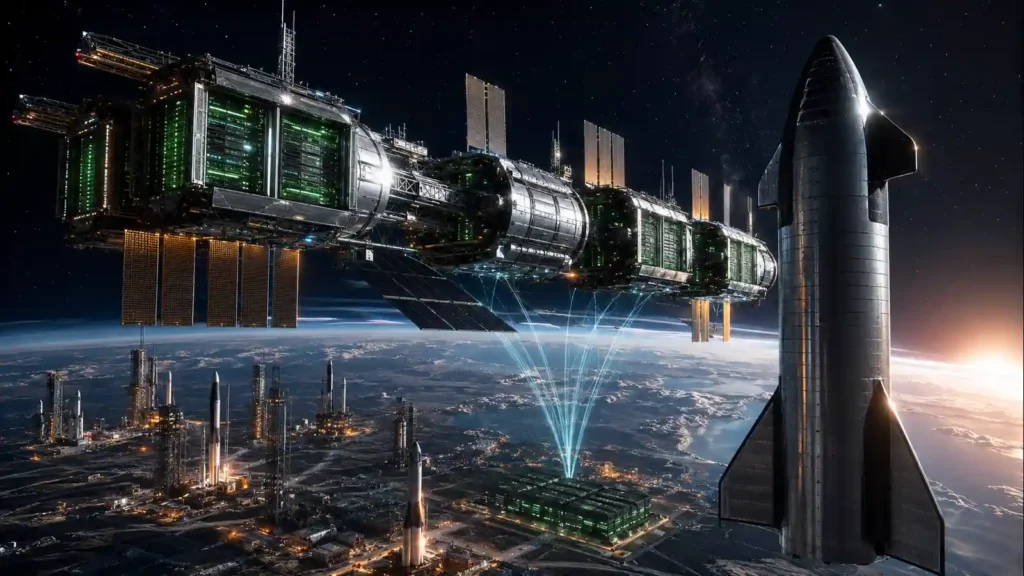
Starcloud raises million dollar ambitions to a new level with a $250 million extension announced on August 21, 2026, lifting the orbital data center startup to a $2.3 billion valuation. The financing will expand manufacturing, advance Starcloud 3, and help reserve scarce rocket capacity for future missions.
The new investment follows a $170 million Series A announced in March at a $1.1 billion valuation. Reuters reports that the extension brings total capital raised since Starcloud was founded in 2024 to $450 million. Manhattan West led the latest financing, with Nvidia, Cisco Investments, Benchmark, EQT, Soma and other backers participating.
This is not simply a bet on putting servers above Earth. It is a bet that Starcloud can manufacture satellites, protect advanced chips from radiation, reject heat through large radiators, move data through orbital networks and buy enough rocket capacity before demand overwhelms supply. Those execution risks now matter as much as the financing headline.
Why Starcloud Raises Million Dollar Stakes in Orbital Compute
Starcloud is using the $250 million extension to move from technical demonstrations toward repeatable manufacturing and commercial missions. The August financing values the company at $2.3 billion, more than twice its $1.1 billion March valuation, while total capital raised reaches $450 million. TechCrunch reported that the money will support a larger manufacturing operation, Starcloud 3 development and launch commitments. Reuters added that the program targets 88,000 satellites and 20 gigawatts of orbital compute, although those figures describe a long range plan rather than deployed capacity. The company is building a 100,000 square foot facility in Woodinville, Washington. Investors are therefore funding an industrial system, not just a satellite: spacecraft assembly, thermal control, radiation tolerant compute, optical networking and access to launch vehicles must all mature together.
What Will the New Starcloud Funding Pay For?
The immediate plan has three connected parts. First, Starcloud is expanding manufacturing around its next spacecraft. Second, it is collaborating with Nvidia on the Space 1 Vera Rubin Module, which Reuters says is designed for radiation and extreme orbital conditions. Third, it wants contracts for enough rocket capacity to deploy successive generations of hardware.
TechCrunch reports that Starcloud currently has 25 employees and is developing production lines at the Woodinville facility. That small headcount makes capital useful, but it also highlights the scale of the operating challenge. Satellite manufacturing, semiconductor qualification, customer workload support and mission operations require different specialist teams. A funding round can buy time and equipment; it cannot remove integration risk.
How Do Starcloud 1, Starcloud 2 and Starcloud 3 Compare?
Starcloud 1 established the technical starting point. The company says the satellite launched in November 2025 with an Nvidia H100 GPU. In December, it ran a version of Google Gemma and trained Andrej Karpathy's nanoGPT model in orbit. These are demonstrations, not evidence that a hyperscale data center already operates in space.
Starcloud 2 is the first planned commercial platform. Starcloud describes it as a small satellite with a GPU cluster, persistent storage, proprietary power and thermal systems, and continuous access in sun synchronous orbit by 2027. TechCrunch says two new 8 kilowatt Starcloud 2 satellites are planned for rideshare launches in 2027 and will process inference workloads for customers that include United States government agencies.
Starcloud 3 is the larger step and the least defined publicly. TechCrunch says it is intended to fly on SpaceX Starship. The company has not published a complete specification sheet, customer schedule or confirmed launch date for that spacecraft. Treating its capacity as settled would therefore go beyond the available evidence.
Why Is Rocket Capacity the Critical Bottleneck?
Orbital compute economics depend on getting heavy, expensive hardware into space at a predictable price and cadence. Starcloud CEO Philip Johnston told TechCrunch, “As soon as we can, we want to get under contract with things like Starship.” The urgency comes from an awkward transition. TechCrunch reports that SpaceX plans to end the Falcon 9 program in 2028, while Starship remains unproven as a rapid and regularly reusable transport system. Blue Origin New Glenn and United Launch Alliance Vulcan are not yet flying frequently, and Rocket Lab Neutron has not reached the launch pad. Starcloud is considering a dedicated Falcon 9 mission and contracts with other providers, but every alternative competes for limited slots. A missed launch window would delay revenue, strand completed hardware on Earth and let chips age before deployment. The financing therefore works partly as strategic inventory: it gives Starcloud the ability to reserve transport before launch scarcity becomes more expensive.
Johnston also told TechCrunch that failing to secure SpaceX capacity in 2029 would be challenging. That statement exposes a key dependency. Starcloud can control satellite engineering and factory output, but it does not control the vehicle central to its largest architecture.
Does an Orbital Data Center Make Technical and Economic Sense?
Starcloud argues that space offers continuous solar power, fewer land and permitting limits, and radiative cooling. Vacuum prevents convection, so heat from GPUs must move through coolant loops and then escape through large radiators. Radiation can also damage electronics, while maintenance, debris avoidance, networking and replacement cycles add costs that ordinary data centers handle differently. Starcloud's 2024 technical white paper models a solar capacity factor above 95 percent and energy generation more than five times that of an equal terrestrial array. Those are company projections based on assumed launch, hardware and operating costs, not independently demonstrated commercial results. The funding gives Starcloud a chance to test those assumptions at larger scale, but it does not validate them in advance.
The distinction matters for investors and customers. Starcloud 1 proved that an H100 can run useful AI work in orbit. Starcloud 2 must show reliable service, workload economics and customer support. Starcloud 3 must then scale production and launch without allowing transport, thermal systems or radiation exposure to erase the energy advantage.
What Does the Round Mean for Nvidia and AI Infrastructure?
Nvidia joined the funding group and is working with Starcloud on its Space 1 Vera Rubin Module. TechCrunch reported, citing a person familiar with the deal, that Nvidia invested $25 million. Nvidia has not publicly confirmed that individual amount in the sources reviewed here, so it should be treated as reported rather than official.
The partnership gives Nvidia operating data from an H100 already in orbit while Starcloud gains a close semiconductor collaborator. It also extends a wider financing shift in which compute, energy and facilities are being treated as one capital stack. BriefFlash has tracked Wall Street funding AI infrastructure, Nvidia infrastructure financing and the planned OpenAI compute campus in Ohio. Starcloud moves the same contest into launch services and orbital manufacturing.
What Should Readers Watch Next?
Three milestones will show whether the valuation is supported by execution:
- Signed launch contracts for Starcloud 2 and Starcloud 3, with providers and windows disclosed.
- Evidence that the two planned 2027 missions deliver stable commercial workloads at useful cost.
- Public performance data for thermal control, radiation tolerance, networking reliability and service availability.
The $250 million extension gives Starcloud more leverage in the fight for launch access. It does not remove the central contradiction of orbital compute: cheaper energy is valuable only if rockets, spacecraft and cooling systems can deliver that energy advantage reliably. The next proof point is not another valuation. It is repeatable service in orbit.
Key Takeaways
- Starcloud added a $250 million funding extension at a $2.3 billion valuation, bringing total capital raised to $450 million.
- The capital will expand manufacturing, support Nvidia engineering work, advance Starcloud 3 and help secure scarce rocket capacity.
- Two 8 kilowatt Starcloud 2 spacecraft are planned for rideshare missions in 2027, while Starcloud 3 depends on the larger Starship architecture.
- Solar power is the attraction, but launch supply, radiation, heat rejection, networking and maintenance remain unresolved commercial risks.
FAQ
How much is Starcloud worth?
Starcloud's latest disclosed private valuation is $2.3 billion following the $250 million extension announced on August 21, 2026. That is a financing valuation, not a public market capitalization or a guarantee of what the company would receive in a sale.
Will Starcloud IPO?
Starcloud has not announced an initial public offering in the verified company, Reuters or TechCrunch materials reviewed for this article. It remains a privately held startup, so any Starcloud IPO date would currently be speculation.
Can I invest in Starcloud?
Starcloud stock is not traded on a public exchange, and no public ticker is listed. Its funding has come through private investment rounds. Access to any future private transaction would depend on eligibility, availability and the terms set by the company or an authorized intermediary.
Who owns Starcloud?
Starcloud is a privately held company founded by Philip Johnston, Ezra Feilden and Adi Oltean. Its ownership is shared among founders, employees and investors, but exact ownership percentages are not publicly disclosed. Named backers include Manhattan West, Nvidia, Cisco Investments, Benchmark, EQT, Soma, NFX and other private investors.