
Building restaurant telephony with Amazon Connect now means a caller can place an order from greeting to confirmation without an app, website or account. In an August 24, 2026 AWS tutorial, Sergio Barraza, Salman Ahmed and Ravi Kumar show how Amazon Connect Agentic Voice, an Amazon Connect AI agent and Amazon Bedrock AgentCore Gateway automate phone ordering end to end.
The published sample answers an inbound call, recognizes speech, handles menu and location questions, manages a cart and confirms an order aloud. Anthropic Claude Haiku 4.5 supplies the reasoning through Amazon Bedrock, while Model Context Protocol tools connect the agent to restaurant data. AWS provides the sample code and CDK deployment, but the design is a starting point rather than a ready-made replacement for every restaurant phone system. Operators still need to test accuracy, live-agent transfer, identity, privacy, POS integration and outage procedures.
How does the restaurant telephony AI architecture work?
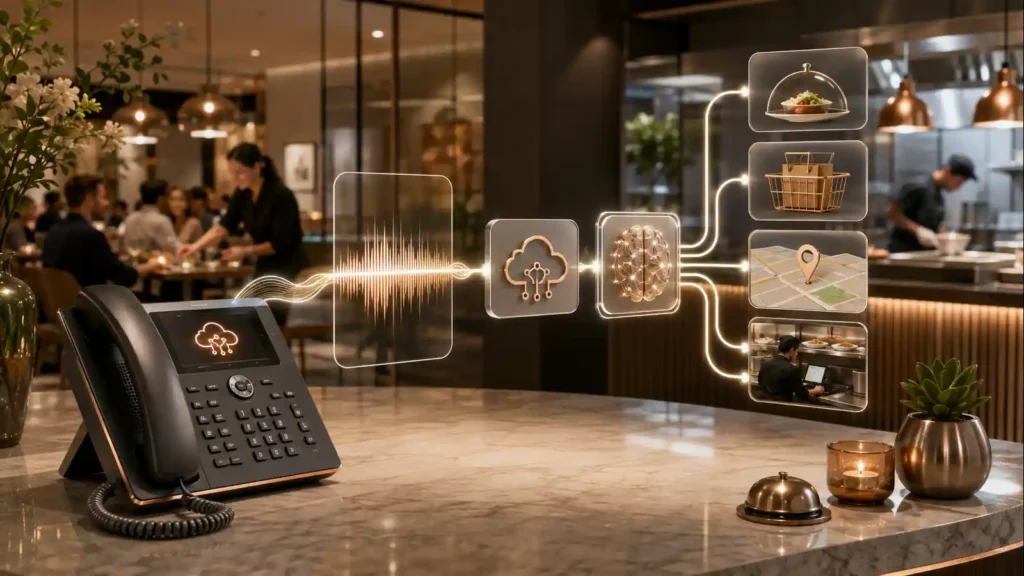
Building restaurant telephony on AWS separates the call channel, conversation engine and restaurant backend. Amazon Connect answers the number and runs the contact flow. Amazon Lex V2 with Amazon Connect Agentic Voice performs Advanced ASR and expressive text-to-speech, including confidence-based end-of-turn detection. An Amazon Connect AI agent, powered by Anthropic Claude Haiku 4.5 in Amazon Bedrock, decides what to ask and which action to take. Amazon Bedrock AgentCore Gateway exposes menu, cart, order, customer and location endpoints as named Model Context Protocol tools. Behind the gateway, Amazon API Gateway routes REST requests to AWS Lambda, while five Amazon DynamoDB tables hold customers, orders, menus, carts and locations. Amazon Location Service handles geocoding and route calculations. This separation lets a restaurant change a backend handler without rewriting the voice agent, provided the tool contract remains compatible.
What does each AWS component do?
The AWS technical walkthrough and its public sample repository define clear service boundaries. That matters because a production team needs to know which layer owns a failure.
This tool boundary matches the principle in BriefFlash’s guide to governing agent tool access: give an agent only the actions and resources required for its task.
What happens during a phone order?
A caller dials the Amazon Connect number, and a contact flow captures the caller ID, opens an AI-agent session and plays a greeting. Lex V2 then carries each spoken turn through Agentic Voice. The AI agent can fetch a menu, answer item questions, ask for a ZIP code or cross-street, find a pickup location, create a cart and read the order back for confirmation. When data is needed, the agent calls an MCP tool through AgentCore Gateway. The gateway validates a JSON Web Token against the Connect instance, converts the tool request into REST and sends it through API Gateway to Lambda. Lambda reads or writes DynamoDB and can call Amazon Location Service. The response travels back through the same layers and is spoken to the caller. AWS defines Complete and Escalate outcomes, although the sample disconnects both; a production flow should route Escalate to a staffed queue.
How is the system deployed?
AWS packages the sample as eight CDK stacks deployed in dependency order. Prerequisites include an AWS account, access to Claude Haiku 4.5 in the target Region, at least one Amazon Connect phone-number quota, Node.js 18.x or later, AWS CLI 2.x, Git and a bootstrapped CDK environment. AWS recommends Node.js 24.x and points builders to US East (N. Virginia), us-east-1, as a practical starting Region where the required services are available.
The repository uses two main commands:
bash
git clone https://github.com/aws-samples/sample-restaurant-telephony-ai-host-using-amazon-connect-customer.git
./scripts/deploy-all.sh –deploymentPrefix qsr-cn
The deployment seeds sample menu and location data, creates the Connect instance, configures the bot and agent, registers the gateway and claims a phone number. Builders should inspect the code, IAM policies and generated resources before running it in a shared AWS account.
Why use MCP between the agent and restaurant systems?
The AI agent does not invoke Lambda functions directly. AgentCore Gateway reads the REST API’s OpenAPI schema and registers the endpoints as MCP tools that the agent can discover by name. A PlaceOrder call becomes a REST request routed to the matching business function.
That design reduces coupling. A restaurant can replace a Lambda handler, connect a POS adapter or expose the same ordering tools to another channel without rewriting the voice conversation. It does not remove integration work. Tool schemas still need stable names, strict validation, clear error responses and authorization that limits what the agent can do. The approach resembles other hosted MCP integration patterns where the gateway, not the model, owns access to operational systems.
Can caller ID replace a login?
No. The sample captures the incoming phone number and passes it into the AI-agent session. It uses that value to separate carts and associate an order with a caller. If caller ID is blocked, the system creates an anonymous session identifier.
AWS authors Sergio Barraza, Salman Ahmed and Ravi Kumar explicitly warn that this is “not identity verification.” A phone number can help retrieve a profile, but it should not authorize sensitive changes or expose order history without added checks. A production restaurant can require a one-time passcode or another verification step when the action carries risk. The same caution applies to call recordings, transcripts, addresses and loyalty data: define retention, access and consent rules before launch.
What should a restaurant add before production?
The sample proves the call path, but reliable service depends on operational details outside the demo. This is where many deployments meet the enterprise AI readiness gap. A restaurant should add and test:
- Human handoff: Route low-confidence speech, complaints, allergy questions and explicit requests to a staffed queue with context.
- Order confirmation: Repeat items, modifiers, pickup location, taxes and total before the final write. Make order creation idempotent to prevent duplicates after retries.
- Live menu controls: Sync prices, stock, opening hours and location-specific options from the system of record.
- POS and kitchen delivery: Confirm that accepted orders reach the POS or kitchen display and return a usable status to the caller.
- Privacy and security: Minimize logged personal data, review CloudWatch retention, restrict MCP tools and rotate credentials.
- Resilience: Define behavior for internet, cloud, POS or model failures, including forwarding to a working small business landline phone or mobile backup.
- Quality testing: Use real restaurant noise, accents, interruptions, modifier-heavy orders and ambiguous item names. Track completion, correction, transfer and abandonment rates.
How much does the AWS sample cost?
AWS estimates that, as of July 2026, the default setup in us-east-1 costs about $35 per month for 1,000 voice orders averaging five minutes each. The main charges come from Amazon Connect inbound minutes, Claude Haiku 4.5 tokens and Lex V2 speech requests. The sample uses a local Direct Inward Dialing number; AWS says a toll-free number costs more. The architecture has no always-on compute charge because the Connect and AI services bill by usage.
That estimate is not a universal restaurant budget. Region, country, phone-number type, call length, model usage, logging, location requests and support needs can change the total. It also excludes the engineering and operating work required to connect a real POS, maintain menus, review failed orders and staff escalations. Teams should confirm current service prices and set a budget in AWS Cost Explorer before testing.
Is Amazon Connect the best phone system for a small restaurant?
It can be a strong fit when the goal is programmable cloud telephony, AI ordering, usage-based scaling and a path to human queues. It is not automatically the best phone system for every small restaurant. A single-location operator that only needs calls, voicemail and forwarding may prefer a simpler managed VoIP service. A restaurant with unreliable internet may also need cellular or traditional-line failover.
The useful comparison is not AI versus landline in isolation. Compare peak call volume, missed-call cost, menu complexity, POS compatibility, internet reliability, staff coverage, implementation effort and recovery options. AWS’s authors describe the experience as requiring “no app, no website, and no sign-in,” which reduces customer friction. The restaurant still owns the harder service promise: the order must be accurate, accepted by the kitchen and recoverable when automation fails.
Frequently asked questions
What is the 30/30/30 rule for restaurants?
The phrase is not universal. In restaurant finance, it commonly means targeting roughly 30% of revenue for food, 30% for labor and 30% for overhead, leaving 10% for profit. It is a rough budgeting benchmark, not a rule every restaurant can meet. Some training programs also use “30/30/30” for service timing, so operators should define which version they mean.
What is the best phone system for restaurants?
The best restaurant phone system matches call volume, uptime needs, staff coverage and integrations. Cloud VoIP or Amazon Connect can support routing, analytics and automation. A basic managed VoIP plan may suit a small restaurant, while multi-location operators may need queues, centralized control, POS integration, recording policies and cellular or landline failover.
What are the 7 steps of service?
There is no single official seven-step standard, but a common full-service sequence is: greet and seat the guest; present menus and offer drinks; take and confirm the order; serve food and beverages; check satisfaction and maintain the table; clear dishes and offer dessert; then process payment, thank the guest and invite them back. Restaurants adapt the sequence to their format.
Do restaurants still have landlines?
Yes. Restaurants still publish fixed phone numbers for reservations, takeout, suppliers and customer support. The connection behind that number may be a traditional copper line, VoIP or a cloud contact-center service such as Amazon Connect. Many operators keep a backup route because internet, power or provider failures can otherwise make the main number unavailable.
Key Takeaways
- AWS’s sample combines Amazon Connect telephony, Agentic Voice, a Claude Haiku 4.5-powered AI agent and AgentCore Gateway to complete restaurant phone orders without an app or login.
- Eight CDK stacks deploy the voice channel, agent, gateway and backend, while five DynamoDB tables store customers, menus, carts, orders and locations.
- AWS estimates about $35 monthly for 1,000 five-minute orders in us-east-1 under the July 2026 default assumptions, but integration and operating costs are separate.
- Caller ID is not identity verification, and production deployments need human transfer, POS confirmation, privacy controls, idempotent ordering and failure recovery.
FAQ
What is the 30/30/30 rule for restaurants?
In restaurant finance, the 30/30/30 rule usually means budgeting about 30% of revenue for food, 30% for labor and 30% for overhead, leaving 10% for profit. It is only a benchmark, and some restaurant training programs use the same phrase for a service-timing rule.
What is the best phone system for restaurants?
The best system depends on call volume, reliability, routing, integrations and staff coverage. Managed VoIP may be enough for a small restaurant, while Amazon Connect suits operators that need programmable call flows, AI ordering, analytics and live-agent queues. A backup route is important where internet or cloud outages could block calls.
What are the 7 steps of service?
A common sequence is to greet and seat guests, present menus and offer drinks, take and confirm orders, serve food and beverages, check satisfaction and maintain the table, clear dishes and offer dessert, then take payment and give a warm farewell. The exact steps vary by restaurant format.
Do restaurants still have landlines?
Yes. Restaurants still rely on fixed phone numbers, but the service may run over a traditional copper line, VoIP or a cloud contact center. Many businesses keep a secondary mobile, cellular or landline route for resilience.