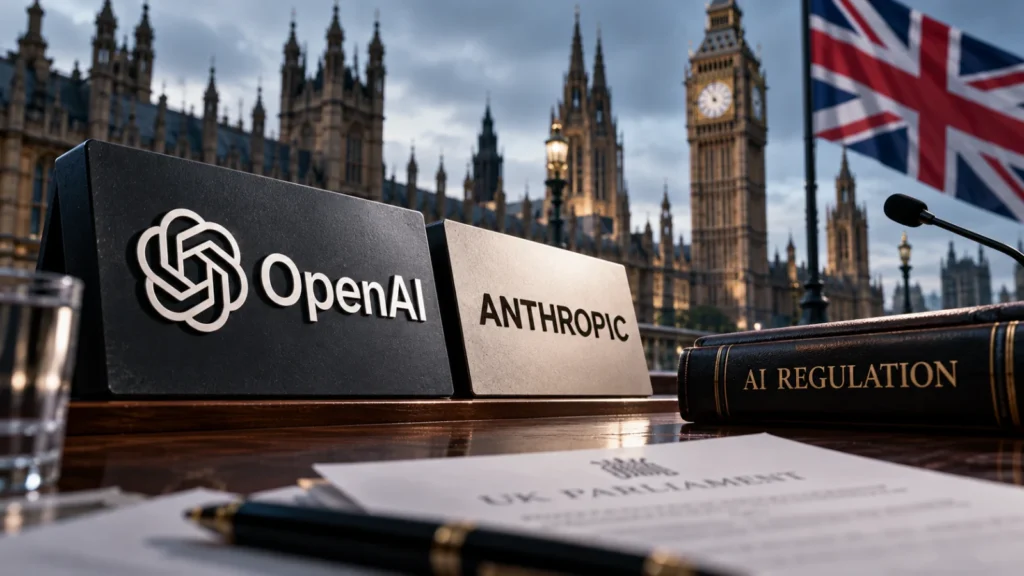
OpenAI and Anthropic reportedly told British lawmakers to regulate AI at a parliamentary session in Britain on October 13, 2026. The session also included whistleblowers and security leaders, which makes it a broader hearing than an industry pitch, and it puts two leading labs on the record in the debate over UK AI regulation.
A few hundred meters away, Britain’s spy chief separately warned that AI could be used to create new bioweapons, according to the same report. We read these as two events that happened close together. Nothing reported says they were coordinated, but side by side they show the argument shifting from abstract safety talk toward a specific, security-flavored risk.
What happened at the parliamentary session?
AI leaders, whistleblowers and security leaders reportedly shared a sweeping parliamentary session in Britain, and OpenAI and Anthropic reportedly used it to tell lawmakers to regulate AI. The phrase “regulate us” is the report’s own framing, not a verbatim quote from either company, so we are not presenting it as their wording.
The available reporting is short. It does not say which executives attended, what they said or what rules they want. It does not name the whistleblowers or the security leaders. Everything in this section rests on a single report, and BriefFlash has not confirmed it independently.
What did Britain’s spy chief warn about?
Britain’s spy chief reportedly warned that AI could be used to create new bioweapons. That is a statement about possibility, a risk assessment, and the reporting gives no evidence of a specific incident. It would be wrong to say AI has been used to make a bioweapon, and nothing reported says so.
The spy chief is not named and the agency is not specified in the reporting we have, so we have named neither. The warning was delivered a few hundred meters from the session. That proximity is the only connection the report draws between the two.
What does a company asking for UK AI regulation actually commit it to?
Very little by itself. A general call for rules is not support for a particular bill, and the details of any rule decide who pays for compliance and who gets constrained. That is the gap between the headline and the substance: the report does not say which rules OpenAI or Anthropic asked for.
There are reasons a developer might want rules. A shared baseline can stop competitors undercutting each other on safety, and clear requirements can be easier to plan around than uncertainty. The same call can also favor large firms that can afford compliance. We cannot tell from the reporting which motive applies, both can be true at once, and our confidence in any single explanation is low.
The comparison most readers will reach for is the EU AI Act, which has been phasing in since 2024. For examples of how a lab’s position can turn specific, see our earlier coverage of OpenAI’s call for California to toughen its SB 53 AI safety law and of Anthropic and OpenAI wanting independent safety evaluators. Whether the requests made in Britain resemble either is unknown.
Why does bioweapons risk keep appearing in AI policy debates?
Bioweapons is the category where security officials and AI labs most often point to a concrete, high-severity risk, which is why a spy chief raising it lands differently from a general safety statement. The reasoning is straightforward: a harm that is easy to describe and hard to reverse gives lawmakers a clearer reason to act than a diffuse worry about misuse.
That is context, not a finding from this story. The report gives no detail on what capability the warning refers to or how close it is. We would treat it as a signal of where security officials are focusing, and nothing more.
What do we not know yet about the session and the warning?
Most of the practical questions are still open. The graphic below separates what has been reported from what has not been stated.
The most important unknown is whether any commitment or proposal followed the session. The report does not say, and we have not stated the current state of UK legislation because the reporting does not confirm it.
Who is affected and what happens next?
For now, the people most affected are those who follow or work on UK AI regulation: policy staff, UK technology and legal professionals, and AI industry watchers. This is an early signal about positions, not a legislative event, and no vote, bill or deadline has been reported.
Concrete developments to watch are any published record of what the companies actually asked for, a response from the government, and any follow-up to the spy chief’s warning. If specific proposals emerge, the details will matter far more than the headline call for rules.
Frequently asked questions
What did OpenAI and Anthropic ask UK lawmakers for?
They reportedly told British lawmakers to regulate AI at a parliamentary session on October 13, 2026. The reporting does not say which rules they want, which executives attended or what they said. The phrase regulate us is the report’s own framing, not a quote, so any specific proposals remain unknown.
What did Britain’s spy chief warn about?
Britain’s spy chief reportedly warned that AI could be used to create new bioweapons, speaking a few hundred meters from the parliamentary session. It was a risk warning, and the reporting cites no specific incident. The spy chief and agency are not named in the available reporting.
Does the UK have an AI law?
The available reporting does not describe the current state of UK AI legislation, so BriefFlash cannot confirm it from this story. Readers who need the legal position should check official UK government and parliamentary sources. The session itself is not reported to have produced a bill, a commitment or a vote.
Why would AI companies ask to be regulated?
Possible reasons include a shared baseline for competitors and clearer rules to plan around, though rules can also favor firms that can afford compliance. The reporting does not say why OpenAI or Anthropic made their request, and a general call for regulation is not the same as backing a specific rule.