Microsoft is reportedly putting together a new Xbox Labs group to explore game modding in the age of AI tools. The report presents the move as the company officially embracing a fan scene that uses decompilation and recompilation to port classic titles to new devices, or to merge code from two different games into one new experience.
The stakes are about permission, and Xbox Labs game modding is where that question now lands. Fan ports built this way have sat in a gray area for rights holders, and Microsoft owns the Halo franchise and, through its Activision acquisition, Call of Duty. When the owner of franchises like those signals interest, modders and developers may read it as a change in posture. What that change amounts to is not yet known.
What is Microsoft doing with Xbox Labs game modding?
Microsoft is reportedly forming a new Xbox Labs group to explore this area, but the available reporting stops before it says what the group will do. No Microsoft statement setting out rules, a roadmap or staffing has been reported.
Two examples of fan work are reported: skateboarding being modded into Call of Duty, and Halo being played in a web browser. Together they show the range of these techniques, from adding an activity to an existing game to moving a game onto a platform it was never built for.
The word embracing is the report’s framing, not a Microsoft policy, and BriefFlash has not confirmed it independently.
What do decompilation and recompilation actually mean?
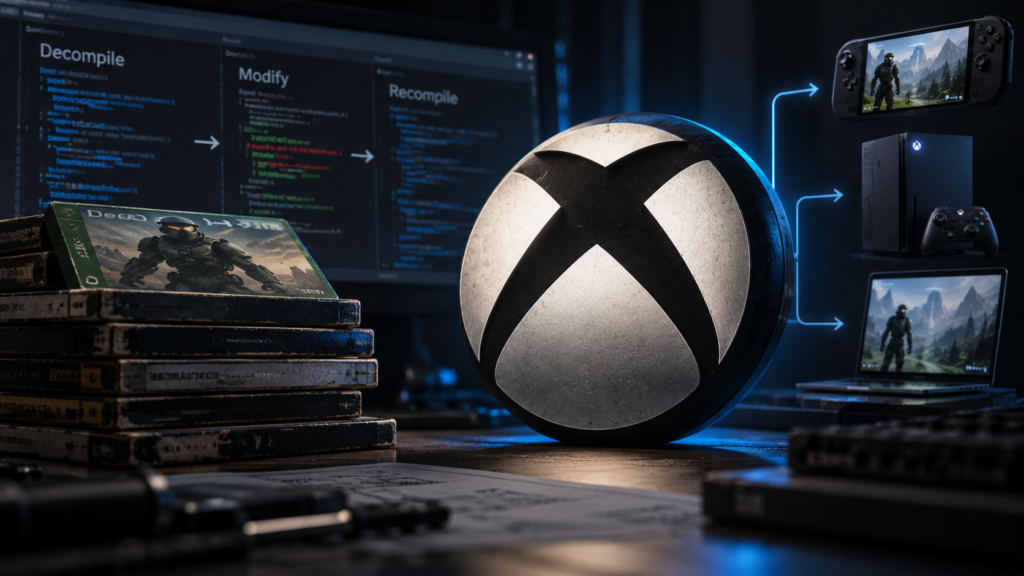
Decompiling turns a finished game program back into readable, source-like code, and recompiling builds that code again so it runs on a new device. A shipped game is a compiled program made for specific hardware, which is hard for a person to read. Decompilation reconstructs something close to the readable form, so people without a studio’s source code can work on it.
Once code is readable, it can be changed. A fan can adjust it to target a new device, which is what a port is, or bring in parts of a second game, which is what a merge is. Recompiling then produces a version that runs where the original never did.
The graphic shows the sequence in general terms. What Xbox Labs itself intends to do with these techniques has not been reported.
Why would a company that owns popular games welcome fan ports?
The reporting does not say Microsoft has approved anything, so what follows is our reasoning, not a finding. Rights holders have generally been wary of fan ports because they involve reworking a company’s own code, which makes a dedicated group notable on its face. Possible motives include goodwill with an active fan community and a preference for engaging with the scene rather than reacting to it. Our confidence in those motives is low.
The consequences differ by reader. For modders, the practical question is whether an official group leads to published rules or changes nothing. For developers interested in game preservation, a company studying decompilation could eventually share guidance, though nothing reported says so. For players, the visible effect so far is limited to the examples already circulating.
Does AI really change how game ports get made?
The report asserts an AI-powered era of modding, but the material available does not show which tools are used or how much they contribute, so treat the AI claim as unproven here. The general reasoning is straightforward: reconstructed code is long and tedious to read, and software that helps people read and rewrite code could cut the effort of a port. That is an inference about the technique, not a result reported about any specific project.
What we do not know yet about Xbox Labs
The reporting leaves several basic questions open:
- What the group will explore beyond the broad area described
- How large it is and who leads it
- When it starts work and what it plans to publish
- Which rules, if any, will apply to fan ports of Microsoft games
- Whether Microsoft will address rights and licensing at all
What should modders and developers watch for next?
Do not treat the report as permission. A group forming is not a licence, and no terms have been reported. Anyone working on a port of a Microsoft title should watch for official terms before sharing or distributing work.
The concrete signals to look for are a statement from Microsoft, a description of what Xbox Labs will do, and any published guidance on fan-made ports.
Frequently asked questions
What is Xbox Labs?
Xbox Labs is a new group Microsoft is reportedly putting together to explore AI-era game modding, including techniques such as decompilation and recompilation. Reports so far do not give its size, leadership, timeline or rules, and no roadmap from Microsoft has been reported. Treat it as an early signal of interest, not a launched program.
What is decompilation in games?
Decompilation turns a finished game program back into readable, source-like code. Recompilation then builds that code again so it runs on a different device. Together they let fans port classic games to new hardware or merge code from two games, without needing the original studio’s source code.
Is porting a game this way legal?
The reporting says nothing about licensing or enforcement, so it does not settle the question. Fan ports rework a rights holder’s own code, which is why they have been a gray area. A company forming a group around the practice does not by itself grant permission. The answer depends on the rights holder’s terms and local law.
Which games have fans already modded?
Reports mention skateboarding being modded into Call of Duty and Halo being played in a web browser. Those are the only specific projects reported so far. They illustrate two different uses of the techniques: adding an activity to an existing game, and moving a game onto a platform it was not built for.