
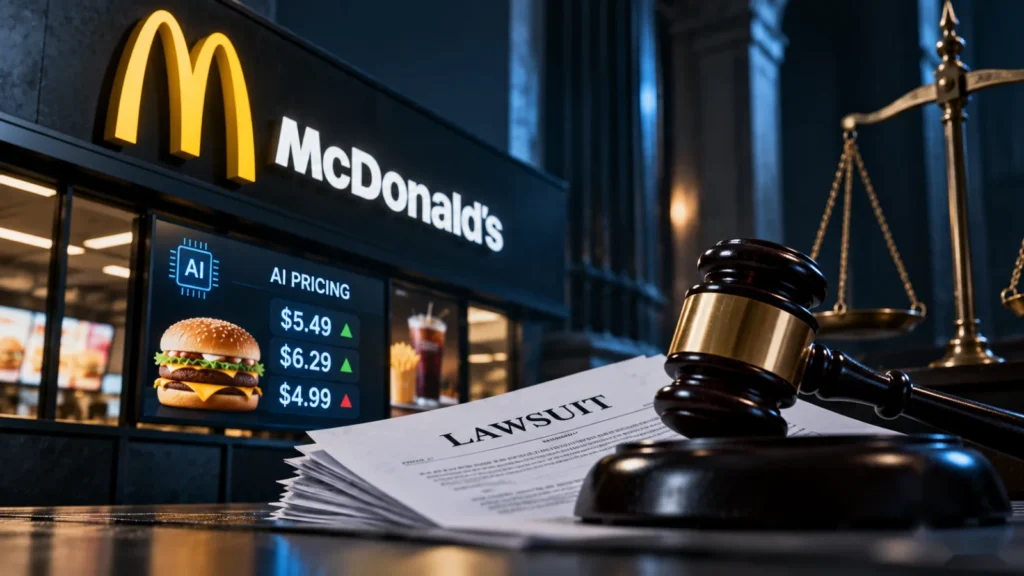
McDonald’s AI pricing has reportedly put the fast-food company in court, according to a headline circulating online. That is everything BriefFlash can say about the McDonald’s AI pricing court case, and even that rests on a single entry.
No court, claimant, date or description of the pricing system is available, so readers should not assume a lawsuit, a class action or a regulator’s action. The question matters to anyone who orders through a restaurant app, because price is where an AI system most directly touches a customer’s wallet. Until details appear, this is a headline, not a ruling on how chains may use automated pricing.
What has been reported about the McDonald’s AI pricing court case?
Only one thing: a headline says the company’s AI pricing has landed it in court. The phrase ‘in court’ can describe a company defending a private or class action, a party to a regulatory proceeding, or a participant in some other dispute, and the headline does not say which.
The ‘AI pricing’ label is also open. It may be the headline writer’s shorthand rather than language from any filing. Because the claim rests on one entry, even the basic framing could shift once a second report or a statement from McDonald’s appears.
What can ‘AI pricing’ mean at a restaurant chain?
It can mean several different things with different consequences for customers. Dynamic or algorithmic pricing means software sets or adjusts a price using signals such as demand, time, location or customer data. The key distinction is between changing a price for everyone and tailoring one to an individual.
| Possible practice | What changes | Who sees the difference |
|---|---|---|
| Demand-based price changes | Prices move with signals such as time or demand | Everyone ordering at that moment |
| Personalized offers or prices in an app | What a customer is shown depends on their data | Individual customers |
| Automated menu price optimization | Software helps decide the standard menu prices | Everyone, over time |
These are general possibilities, not a description of McDonald’s system, which we know nothing about. Restaurant chains increasingly run ordering through apps, which gives them more data and more control over how prices and offers appear. That is why the distinction matters: the first and third rows change what everyone pays, while the second changes what a particular person sees. We have no basis to say which, if any, applies here.
How do courts and regulators generally view algorithmic pricing?
Algorithmic pricing is not inherently unlawful. The general questions concern disclosure, discrimination and deception, and none of them is a claim in this case.
- Are prices clearly disclosed to customers?
- Are different customers charged different amounts, and on what basis?
- Is the practice misleading?
- Who bears responsibility when software sets the price?
Does being in court mean McDonald’s did something wrong?
No. Appearing in court is not a finding of wrongdoing. A company can be a defendant in a case that goes nowhere or a party to a dispute in which no rule was broken. Until a filing or decision is public, BriefFlash cannot say what is alleged, let alone whether it has merit.
Which missing facts will decide whether the case matters?
Six unanswered questions would turn the headline into something readers can judge. The graphic sets them against the one reported fact.
We think the claimant and the alleged practice matter most. Together they show whether this concerns customers, competitors or a regulator, and whether it is about disclosure, discrimination or something else. That is our judgment about the framework, held with moderate confidence.
What we do not know yet
We do not know who brought the action, which court is involved, what practice is alleged, what remedy is sought, whether prices changed for customers or by how much, or what McDonald’s has said. We also do not know how this fits with scrutiny of other automated pricing systems. No reaction from the company, customers or regulators is available, and we will not guess at any.
What can customers and operators do in the meantime?
Customers can compare the app price with the in-store price for the same item. It is a simple way to see how pricing varies, and it is general advice, not evidence about this case. For restaurant and retail operators, the consequence is conditional: if the case turns out to concern how automated pricing is disclosed or tailored, it could shape how other chains use such systems, but nothing yet shows that.
The next report should say who brought the action and in which court. For a comparable what-we-know treatment of a different legal story, see OpenAI Sued Over Hugging Face Hack. A separate BriefFlash piece on Chargebee and AI pricing covers the term in another setting.
Frequently asked questions
Is AI-based pricing legal for restaurants?
Algorithmic pricing is not inherently unlawful. Courts and regulators generally ask whether prices are disclosed, whether different customers are charged different amounts, whether the practice is misleading, and who is responsible when software sets a price. Whether any of that applies to McDonald’s is unknown, because the reported court matter has no public details.
What is the difference between dynamic pricing and personalized pricing?
Dynamic pricing changes a price for everyone based on signals such as demand, time or location. Personalized pricing tailors what a particular customer is shown or charged, using data about that person. The two raise different questions, and the reported McDonald’s matter does not say which, if either, is involved.
Does being in court mean McDonald’s did something wrong?
No. Appearing in court is not a finding of wrongdoing. A company may be a defendant in a private or class action, the subject of a regulatory proceeding, or a party to another kind of dispute. The headline does not say which, so nothing can be concluded about the company’s conduct.
How can I tell if an app price differs from the in-store price?
Compare the price of the same item in the app and at the counter. This is general advice for seeing how pricing varies, not evidence about this case. A difference can have many explanations, so it shows variation, not wrongdoing.
What details should I watch for in the next reports?
Look for who brought the action, which court or jurisdiction is involved, what pricing practice is alleged, whether it is a private suit, class action or regulatory matter, and what stage it has reached. A statement from McDonald’s would also help. Those details decide whether the case is significant.