OpenAI’s first custom inference chip delivered 1.5 to 1.9 times more work per watt and 1.7 to 3.6 times lower latency than the tested NVIDIA Blackwell systems. The early results are promising, but they come from engineering silicon and a limited benchmark workload.
OpenAI is expanding agents from coding into everyday knowledge work, but adoption data shows that trust, usability, and governance remain major barriers.
OpenAI and AWS are positioning GPT‑5.6 Sol, Terra, and Luna as three cost-capability choices inside Kiro. A Terra test showed roughly 82% lower cost for successful Terminal‑Bench 2.1 tasks, but the result needs careful interpretation.
OpenAI is asking California to strengthen SB 53, the AI safety law it once opposed, calling for closer monitoring of frontier models during training and tighter cybersecurity rules after a security incident involving one of its own models.
OpenAI’s flagship GPT-5.6 Sol model is now half price on AI Gateway through September 18, dropping output token costs to $15 per million. The discount requires no code changes and applies across all service tiers.
OpenAI has officially joined the PORTS-Pike technology campus project, committing to a massive infrastructure buildout that will secure up to 8 gigawatts of compute capacity and support thousands of jobs in Southern Ohio.
OpenAI details how AI is fundamentally altering the cybersecurity landscape, creating a critical defender’s window where advanced models like GPT-5.6-Cyber can neutralize threats before they spread.
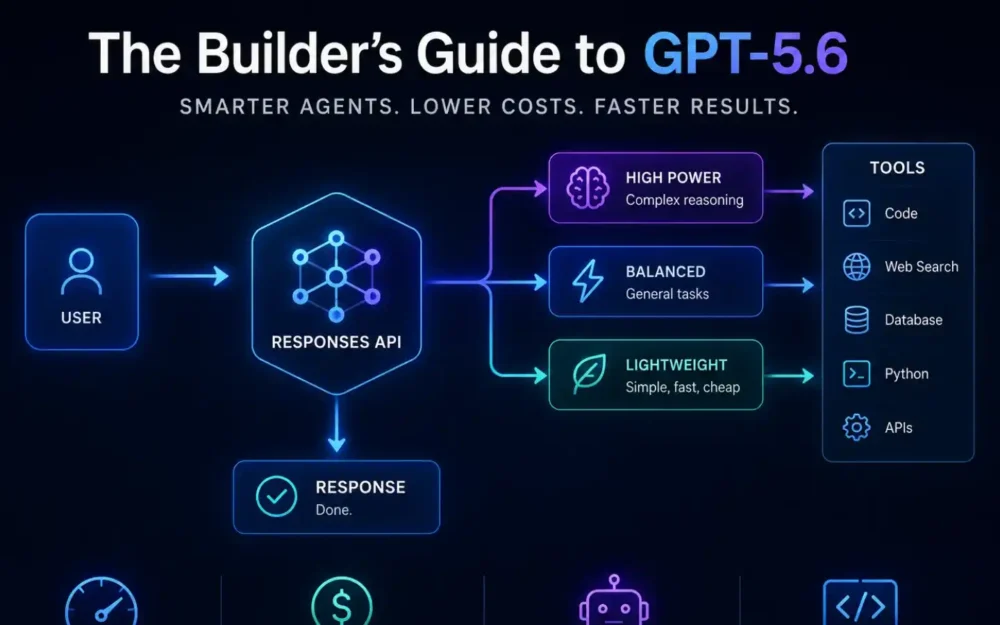
OpenAI’s latest release provides a blueprint for startups to build faster, more cost-efficient AI agents using GPT-5.6’s smarter model selection and the Responses API.
OpenAI introduces Ultrafast, a new API service tier that runs GPT-5.6 Sol up to 14 times faster using Cerebras architecture, delivering 750 output tokens per second.