

The PriceBench LLM booking agents paper on arXiv proposes a way to measure something shoppers rarely see: what an AI model quietly prefers when it books a hotel for them. The benchmark treats each booking as evidence of how the model weighs price, quality and brand.
The stakes come from the paper’s own premise. Once an LLM acts as a purchasing agent, the model chooses among the options that satisfy a request, and the user does not. The abstract gives the setup but no results, so this piece explains the method and the open question, not any finding.
How does the PriceBench LLM booking agents benchmark work?
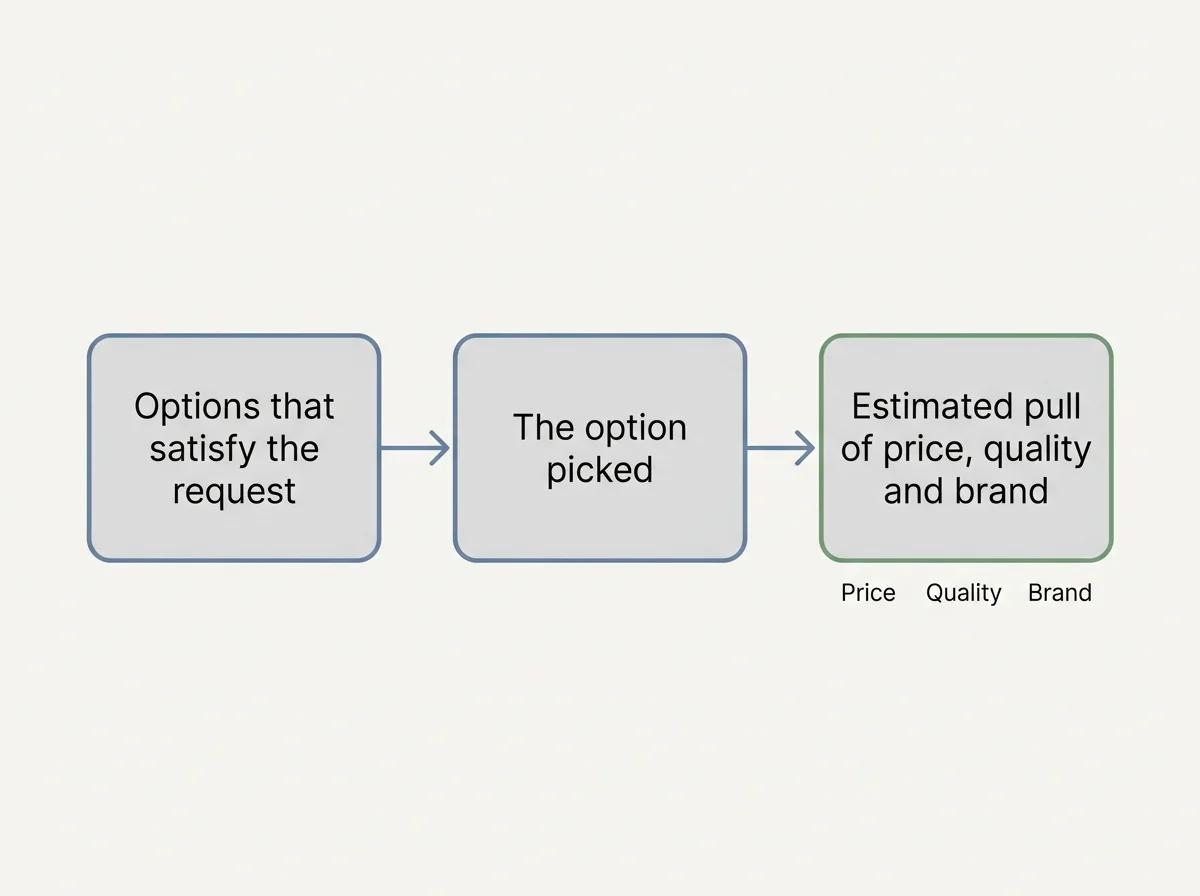
PriceBench is a diagnostic benchmark that recovers an LLM’s price, quality and brand preferences from its booking choices using a logit choice model, according to its arXiv abstract. The approach is to watch what an agent picks and work backward to what it valued.
The visible abstract stops after the logit choice model clause. The models tested, the scale of the experiments and the conclusions are therefore unknown.
Working backward from choices is an old idea in economics, and it suits this problem. A model cannot simply be asked to list its leanings in a way anyone should trust, but its picks across many comparable options leave a pattern. That is my framing of the general approach, not a description of the paper’s procedure.
Why use hotel booking to test an AI agent?
The abstract calls hotel booking a clean instance of the problem: a high volume choice settled on a few comparable attributes, where the pick reveals the preferences. Hotels can be compared on price, quality and brand, so a chosen room says something about which of those pulled hardest.
Two phrases in that wording matter, in my reading. High volume suggests the choice repeats often enough for patterns to show. A few comparable attributes keeps the comparison from being swamped by everything else that separates one hotel from another.
It is also a narrow test bed. Hotel booking is one domain, and nothing available shows that the approach carries over to other purchases.
What is a logit choice model?
A logit choice model is a standard statistical tool from economics. Given a set of options and the one picked, it estimates how strongly each attribute pulled the decision. In PriceBench, that turns an agent’s booking picks into estimates of how much price, quality and brand mattered.
The paper’s exact specification is not in the material available to the desk, so treat this as general background.
Who is affected when an AI agent does the buying?
Three groups have a stake. What follows is my analysis, not the paper’s findings.
- Shoppers. On a booking site, a person sees the options. An agent narrows the set first, so its preferences act before the user sees anything.
- Hotels and brands. An agent’s leaning could favour some properties and penalize others. The abstract reports no results on which.
- Agent builders. If preferences can be recovered from choices, design decisions become measurable.
The word quietly in the abstract carries much of the argument. A wrong answer from a chatbot is visible on the screen. If an agent leaned toward pricier or better known hotels, the booking would still look like a normal booking, and nothing on a confirmation page would show what was passed over. That is my reading of why a measurement tool is needed, not a result.
People already hand money decisions to models. The RupeeBias paper notes that people turn to LLMs to compare loan options, plan savings, decide what raise to ask for and set prices for their services.
One further link is my own inference. An agent that weighs quality may lean on ratings and reviews, and a fake review survey in the same arXiv feed says fake reviews inject deceptive evidence into rating systems and recommendation pipelines.
BriefFlash has covered the controls being built for agents in Nvidia’s agent safety platform and the tracing question in LLM watermarking for AI agents.
Does more reasoning make an agent choose better?
A companion paper asks that question about trading, and the material available gives no answer. The Price of Thought: Does Test-Time Reasoning Pay in LLM Trading? says inference time reasoning promises better decisions but costs more compute, and that reasoning controls are rarely evaluated as economic interventions.
It covers trading, not booking, so it appears here only as a second example of researchers treating LLM decisions as economic behaviour. Background on how reasoning models are trained is in our explainer on reasoning training.
What do the abstracts not show?
Most of what a reader would want. The table separates what the PriceBench abstract states from what the desk cannot report.
| Item | What the abstract says | What is not shown |
|---|---|---|
| Dimensions | Price, quality, brand | Any ranking of them |
| Domain | Hotel booking | Other purchase types |
| Method | Logit choice model | The exact specification |
| Evidence | Setup only | Results, models tested, sample sizes |
| Verification | Authors’ own benchmark | Independent replication |
Preferences is the paper’s term for what choices reveal, and it does not imply intent or deliberate bias. The listings that carried PriceBench are arXiv category feeds carrying one paper, so this rests on a single primary source. Both papers are preprints, posted before peer review.
A benchmark introduced by its own authors deserves the same patience as a vendor claim. I would wait for the paper’s actual results and for independent replication before treating any statement about how a specific model behaves as established.
What should readers watch next?
Watch for the paper’s results and which models were tested, independent replication, and whether agent platforms ever disclose their agents’ preferences. Until then, PriceBench is a method for asking the question, not an answer to it.
For anyone using an agent for bookings today, my suggestion is simple: ask it to show the alternatives it considered and compare them against your own priorities. That is practical advice, not a result from the paper, and it does not depend on the benchmark.
Frequently asked questions
What is PriceBench?
PriceBench is an arXiv diagnostic benchmark that recovers an LLM’s price, quality and brand preferences from its hotel booking choices using a logit choice model. Its abstract says LLMs increasingly act as purchasing agents, so the model rather than the user picks among options. The abstract available to BriefFlash on September 28, 2026 reports no results.
Why use hotel booking to test an AI agent?
The PriceBench abstract calls hotel booking a clean instance: a high volume choice settled on a few comparable attributes, where the pick reveals the chooser’s preferences. Hotels can be compared on price, quality and brand, so each choice offers evidence. It is still one domain, and results may not carry over to other purchases.
What is a logit choice model?
A logit choice model is a standard statistical method from economics. Given a set of options and the one chosen, it estimates how strongly each attribute, such as price, quality or brand, pulled the decision. PriceBench uses one to turn an LLM’s booking choices into preference estimates. Its exact specification is not in the available abstract.
Can an AI agent be trusted to pick the cheapest or best option?
The available PriceBench abstract reports no results, so it cannot say. What it offers is a method for measuring an agent’s leanings on price, quality and brand from its choices. Until results are disclosed and independently replicated, a user cannot assume an agent’s picks match their own priorities.